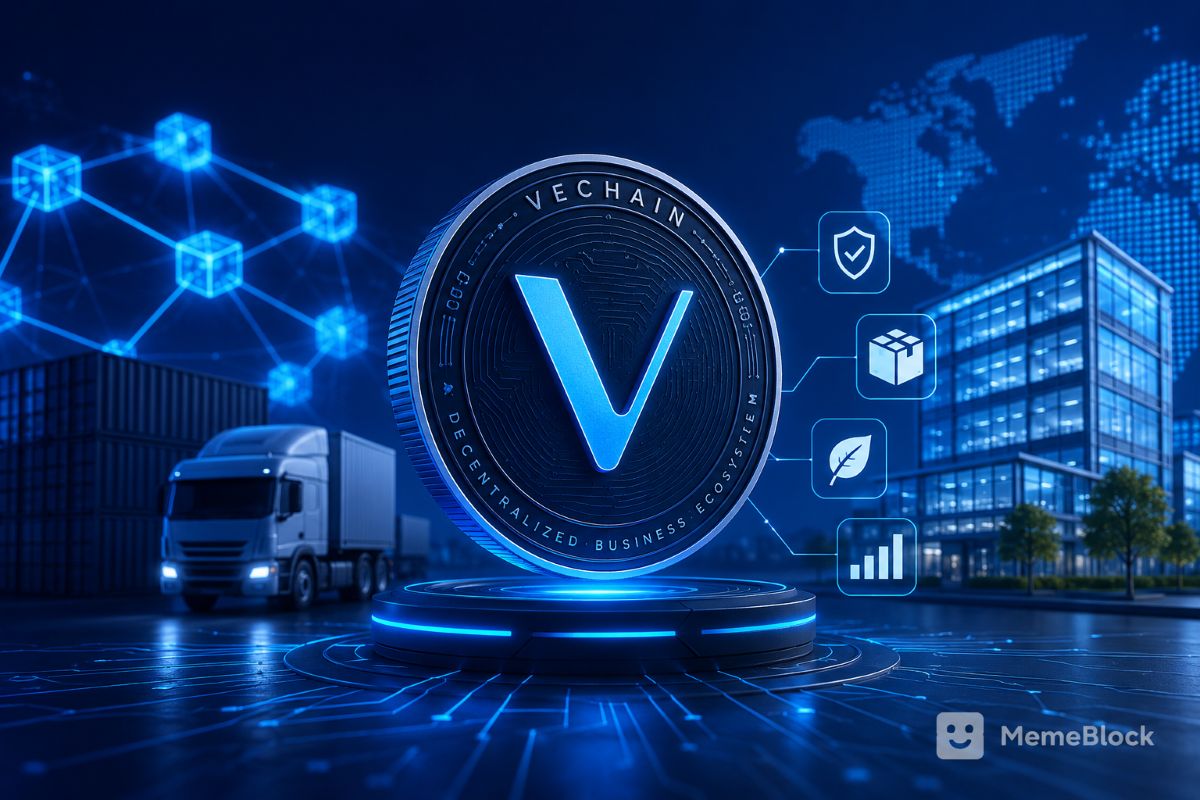
VeChain is one of the longest-running enterprise blockchain projects focused on solving real-world business problems. Unlike memecoins or purely speculative crypto assets, VeChain was designed to improve supply chain management, product verification, sustainability tracking, and data transparency across industries.
The VeChain ecosystem operates on the VeChainThor blockchain and uses a dual-token model. VET acts as the primary value-transfer token, while VTHO is used to pay network transaction fees. This setup helps businesses maintain predictable operating costs even during periods of crypto market volatility.
Today, VeChain is widely recognized for its enterprise-first approach and partnerships involving logistics, food safety, luxury goods authentication, carbon tracking, and pharmaceutical verification systems.
How VeChain Blockchain Technology Works
VeChain uses a Proof-of-Authority consensus mechanism, commonly called PoA. Unlike energy-intensive mining systems, PoA relies on approved validators to confirm transactions. This makes the network faster, cheaper, and significantly more energy efficient than traditional Proof-of-Work blockchains.
One of VeChain’s biggest advantages is its focus on practical adoption. Businesses can integrate blockchain tracking tools without requiring customers to understand cryptocurrency wallets or decentralized finance.
Real-World VeChain Use Cases Driving Enterprise Adoption
VeChain has built its reputation around commercial utility instead of hype-driven speculation. Several major industries already use blockchain-based verification and traceability tools powered by VeChain technology.
Supply Chain and Logistics
VeChain helps companies track goods from manufacturing to delivery. This improves transparency, reduces fraud, and increases efficiency across global supply chains.
Retailers and manufacturers can verify product origins, shipping conditions, and inventory records using immutable blockchain data. Analysts continue to highlight partnerships involving companies like Walmart China and BMW as examples of real-world blockchain deployment.
Food Safety and Pharmaceuticals
Food safety has become a massive concern worldwide. VeChain technology allows businesses to monitor food handling conditions and verify product authenticity.
In the pharmaceutical sector, VeChain solutions are used to fight counterfeit medicine distribution and improve drug traceability systems. Reports show blockchain verification systems processing millions of enterprise transactions through food and pharmaceutical tracking applications.
Sustainability and Carbon Tracking
One area where VeChain stands out is sustainability infrastructure. The project has invested heavily in carbon tracking and ESG-focused blockchain solutions.
The VeCarbon platform helps enterprises track emissions and environmental impact data using blockchain verification tools. Reports from 2026 indicate that VeChain’s sustainability initiatives are expanding across both European and Asian enterprise markets.
VeChainThor 2.0 and Recent Ecosystem Developments
VeChain continues evolving through major ecosystem upgrades aimed at scalability, interoperability, and decentralization improvements.
Recent updates include the Galactica upgrade and broader VeChainThor 2.0 development plans focused on dynamic fee structures, improved developer tools, and cross-chain communication capabilities.
The VeChain Foundation also revealed plans to expand validator participation, improve staking systems, and strengthen governance mechanisms throughout 2026.
These upgrades are important because they move VeChain beyond simple supply chain tracking into a broader enterprise blockchain ecosystem capable of supporting Web3 infrastructure and sustainable business applications.
Is VeChain (VET) a Strong Long-Term Crypto Project?
VeChain remains one of the few blockchain projects consistently focused on business adoption rather than short-term market speculation.
Its long-term potential depends heavily on enterprise usage growth, transaction volume expansion, and continued adoption of blockchain-based sustainability solutions. Analysts frequently point to VeChain’s low-energy infrastructure, enterprise partnerships, and utility-driven tokenomics as major strengths.
However, investors should also understand the risks. Competition from other enterprise blockchain platforms, regulatory uncertainty, and broader cryptocurrency market conditions could impact future performance.
Still, VeChain continues positioning itself as a practical blockchain network built for real-world economic activity rather than hype cycles alone.