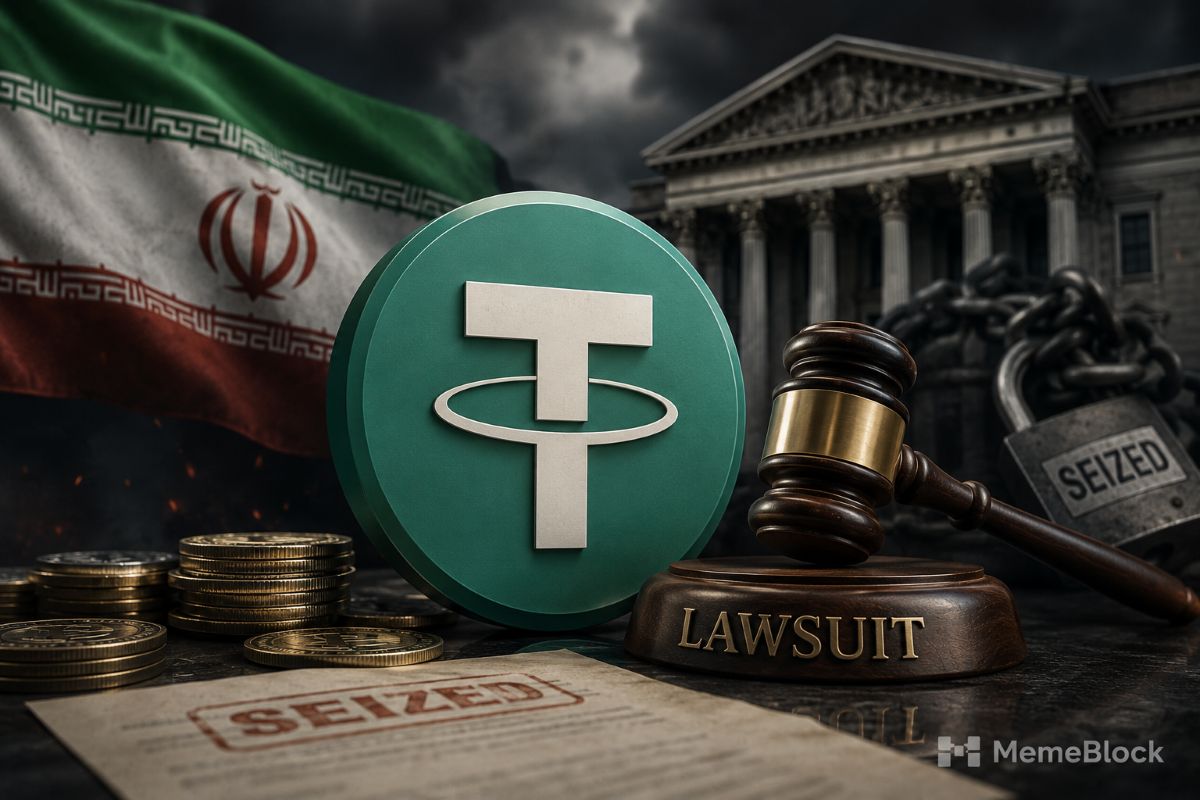
In a decisive move against digital financial crime, Tether, the world’s largest stablecoin issuer, announced that its newly formed Tether-Backed Crime Unit (TBCU) has frozen over $300 million in illicit crypto funds linked to money laundering, scams, and exchange exploits across multiple blockchains. The operation marks one of the largest-ever stablecoin-based crime prevention actions in the crypto industry, underscoring the growing role of private sector enforcement in global financial integrity.
Tether’s Crime Unit Cracks Down on Crypto Criminals
The Tether-Backed Crime Unit, launched earlier this year, is an internal investigative division that works with law enforcement agencies, blockchain analytics firms, and regulatory authorities worldwide. Its mission is to track, trace, and freeze illicit assets circulating through the USDT stablecoin ecosystem, which currently boasts a market capitalization exceeding $120 billion.
In this latest enforcement action, Tether identified suspicious activity spanning multiple chains, including Ethereum, Tron, and Solana, where bad actors were using USDT to move funds from fraudulent exchanges, darknet marketplaces, and phishing scams. After confirming links to known wallet addresses flagged by authorities, the TBCU executed on-chain freezes, effectively cutting off the perpetrators’ access to the tainted funds.
Expanding Role in Global Crypto Enforcement
Tether CEO Paolo Ardoino described the operation as “a breakthrough in the private sector’s ability to assist law enforcement in real time.” He emphasized that blockchain transparency enables Tether to act swiftly and precisely, unlike traditional banking systems, where money can move undetected for days.
Over the past year, Tether has collaborated with more than 40 law enforcement agencies globally, including the U.S. Department of Justice, Europol, and INTERPOL, to counter illicit crypto flows. Since 2022, the company has frozen over $1 billion in digital assets tied to cybercrime, terror financing, and ransomware.
Analysts note that Tether’s proactive measures are reshaping the perception of stablecoins as compliance-friendly tools rather than risk vectors. “The days of stablecoins being viewed as the ‘Wild West’ of crypto are ending,” said one market strategist. “Tether’s compliance infrastructure is now among the most sophisticated in the blockchain ecosystem.”
Strengthening Trust Amid Regulatory Oversight
This milestone comes at a crucial time, as regulators worldwide tighten oversight of stablecoins. In the United States, Treasury Secretary David Bessent has been promoting cross-border cooperation to ensure stablecoin transparency, while the European Union’s MiCA framework has set global standards for digital asset reporting and consumer protection.
By implementing these enforcement mechanisms, Tether is signaling a long-term commitment to financial transparency, potentially paving the way for greater institutional adoption of stablecoins in global trade and payments.
Industry Reaction
The broader crypto community has welcomed Tether’s crackdown, viewing it as a positive step toward self-regulation and a signal of the industry’s maturity. Bitcoin (BTC) and Ethereum (ETH) both held steady following the announcement, while USDT’s peg remained stable at $1, reaffirming market confidence.
Experts believe this kind of real-time blockchain enforcement could serve as a model for other stablecoin issuers like Circle and PayPal as regulators demand higher compliance standards.
FAQs
1. What is the Tether-Backed Crime Unit (TBCU)?
It’s a specialized internal task force established by Tether to monitor, track, and freeze illicit crypto funds across blockchain networks.
2. How much has Tether frozen in this operation?
Tether’s Crime Unit has frozen over $300 million linked to criminal activity, one of the largest actions of its kind.
3. Which blockchains were involved in the investigation?
The investigation spanned Ethereum, Tron, and Solana, where illicit USDT transfers were detected.
4. How does this affect legitimate USDT users?
Regular users are unaffected; the freezes only apply to wallets flagged for illegal activity verified by law enforcement.
5. What does this mean for the future of stablecoins?
This operation strengthens the case for regulated, transparent stablecoins and could lead to broader institutional trust and adoption.