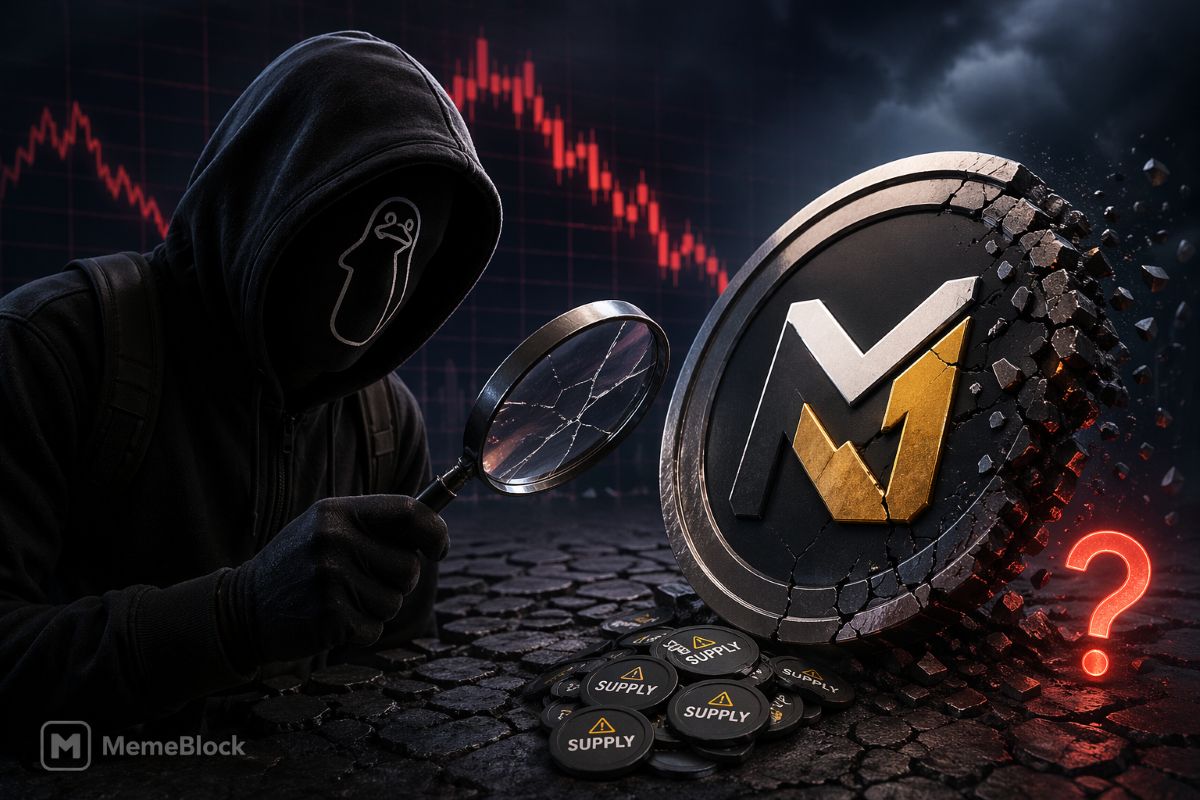
The crypto market is once again facing turbulence as on-chain investigator ZachXBT publicly challenges MemeCore over its multibillion-dollar valuation and controversial token distribution. This scrutiny comes at a time when meme-based digital assets are experiencing heightened volatility. As a result, there are fresh concerns about transparency, liquidity, and investor risk.
ZachXBT Raises Serious Questions About MemeCore’s Valuation
ZachXBT, widely known for uncovering irregularities in blockchain projects, has called on MemeCore to justify how its native “M” token reached a valuation approaching $6 billion. The investigator questioned the lack of clear data supporting such a high market cap. This is especially concerning for a relatively new project claiming to build a “Meme 2.0” ecosystem.
In a public statement, ZachXBT urged the team to provide concrete metrics validating the token’s position among top-ranked cryptocurrencies. The request reflects growing skepticism among analysts who argue that inflated valuations without strong fundamentals often signal speculative bubbles.
Token Supply Concentration Sparks Investor Concerns
One of the biggest red flags highlighted is the concentration of the token supply. Reports suggest that insiders or a small group of wallets may control more than 90% of MemeCore’s circulating tokens. Consequently, this raises questions about decentralization and market fairness.
Blockchain data further indicates that a significant portion of tokens is held by just a few addresses. This limits the actual circulating supply available to retail investors. As a result, this structure can lead to extreme price volatility and make the asset vulnerable to sudden sell-offs.
Such concentration also creates a liquidity illusion, where the market cap appears large. However, the tradable supply remains minimal and may potentially mislead investors about the token’s real value.
Gap Between Valuation and Real Usage
Another major criticism revolves around the disconnect between MemeCore’s valuation and its real-world usage. According to reports, the platform has recorded relatively low application activity compared to its multi-billion-dollar valuation.
This discrepancy has intensified doubts about whether the price surge is driven by organic adoption or speculative trading. Analysts warn that such mismatches are often seen in projects that experience rapid price increases. In many cases, there is no corresponding utility or ecosystem growth.
Market Reaction and Price Volatility
Following ZachXBT’s comments, MemeCore’s token experienced noticeable price swings, with volatility increasing significantly in a short period.
The broader crypto community remains divided. While some traders defend the project’s long-term vision, others view the current structure as a potential risk for retail investors. The situation mirrors previous cases where high-profile tokens saw dramatic rises followed by sharp corrections.
Comparisons to Past Crypto Collapses
The controversy surrounding MemeCore has drawn comparisons to earlier incidents in the crypto space. In particular, it is being compared to tokens that surged rapidly before collapsing due to concentrated ownership and lack of transparency.
ZachXBT himself has linked MemeCore to a group of tokens exhibiting “highly questionable price action.” This suggests that similar warning signs may already be present.
These comparisons have amplified fears of a potential correction if underlying concerns remain unresolved.
Calls for Transparency and Accountability
Industry experts are now urging MemeCore’s team to provide detailed disclosures about tokenomics, wallet distribution, and actual circulating supply. Transparency is increasingly seen as critical in maintaining investor confidence, especially in the volatile memecoin sector.
Without clear answers, the project risks losing credibility among both institutional and retail participants.
What This Means for Investors
For investors, the MemeCore controversy highlights the importance of due diligence in crypto markets. High valuations and rapid price increases should always be evaluated alongside factors like token distribution, liquidity, and real-world adoption.
As the investigation unfolds, MemeCore’s future will likely depend on how effectively it addresses these concerns. Until then, market participants are expected to remain cautious amid ongoing uncertainty.