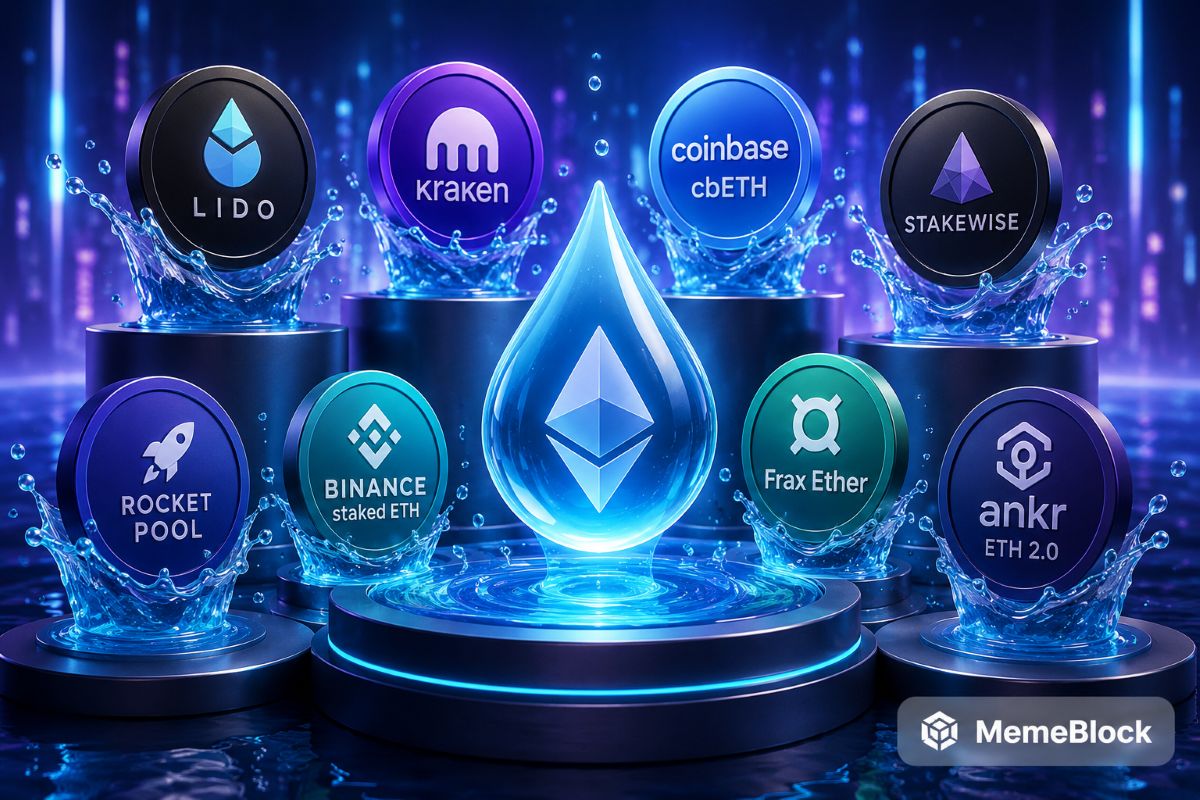
Liquid staking has become one of the fastest-growing sectors in decentralized finance (DeFi), allowing crypto holders to earn staking rewards while keeping their assets liquid for trading, lending, and other yield-generating opportunities. As Ethereum, Solana, and several other proof-of-stake networks continue expanding, liquid staking protocols have become essential infrastructure for investors seeking capital efficiency.
Here are the top eight liquid staking protocols and platforms leading the market in July 2026.
1. Lido
Lido remains the undisputed leader in liquid staking. The protocol allows users to stake ETH and receive stETH, which can be used across numerous DeFi applications while continuing to generate staking rewards.
Its deep liquidity, extensive integrations with lending protocols, decentralized exchanges, and restaking platforms make it the preferred choice for many Ethereum investors. Despite ongoing discussions about validator concentration, Lido continues to dominate the liquid staking landscape through broad adoption and strong ecosystem support.
2. Ether.fi
Ether.fi has emerged as one of Ethereum’s fastest-growing liquid restaking platforms. Users receive eETH after staking, enabling participation across DeFi while accessing additional yield opportunities through Ethereum’s expanding restaking ecosystem.
The protocol’s self-custody approach and integration with multiple decentralized services have attracted both retail and institutional users seeking greater flexibility than traditional staking.
3. Rocket Pool
Rocket Pool continues to stand out for its commitment to decentralization. Unlike larger staking providers, it distributes validator responsibilities across thousands of independent node operators.
Users receive rETH after staking, a liquid staking token widely accepted throughout Ethereum DeFi. Investors prioritizing decentralization often choose Rocket Pool because of its permissionless validator model and transparent governance.
4. Jito
Jito remains Solana’s leading liquid staking protocol. Users stake SOL and receive JitoSOL, allowing them to earn staking rewards while participating throughout Solana’s DeFi ecosystem.
Its integration of Maximum Extractable Value (MEV) optimization helps generate additional yield, making Jito particularly attractive for investors looking to maximize staking efficiency on Solana.
5. Marinade Finance
Marinade Finance continues to play a major role within the Solana ecosystem through its mSOL liquid staking token.
The protocol automatically distributes delegated stake across numerous validators, improving decentralization while providing users with liquid assets that can be deployed throughout Solana’s rapidly growing DeFi applications.
6. Binance Liquid Staking
Binance offers one of the easiest entry points into liquid staking through its exchange platform. Users can stake supported assets and receive liquid staking tokens such as WBETH without navigating multiple decentralized applications.
Although more centralized than decentralized alternatives, Binance appeals to beginners thanks to its simple interface, strong liquidity, and seamless staking experience.
7. StakeWise
StakeWise continues to expand as a transparent Ethereum liquid staking platform focused on flexible staking infrastructure.
Its modular design supports both individual investors and institutions seeking customizable validator solutions. The protocol emphasizes transparency while offering liquid staking assets that integrate across the broader Ethereum ecosystem.
8. Frax Ether
Frax Ether provides an innovative dual-token liquid staking model through frxETH and sfrxETH.
This structure allows users to choose between maintaining liquidity and maximizing staking yield depending on their investment strategy. Its integration with the wider Frax ecosystem makes it attractive for advanced DeFi participants looking for additional capital efficiency.
What Makes These Platforms Stand Out?
The strongest liquid staking protocols typically share several characteristics:
- Proven smart contract security and audits
- Deep DeFi integrations
- High liquidity for staking tokens
- Reliable validator performance
- Transparent governance
- Sustainable staking rewards
- Broad ecosystem adoption
These factors have become increasingly important as liquid staking evolves beyond simple staking into restaking, lending, collateralization, and advanced yield strategies.
Final Thoughts
Liquid staking continues transforming how crypto investors generate passive income without sacrificing liquidity. While Ethereum remains the largest liquid staking market through protocols like Lido, Ether.fi, and Rocket Pool, Solana platforms such as Jito and Marinade Finance are rapidly expanding their market presence.
Before selecting a liquid staking platform, investors should evaluate decentralization, security history, validator quality, liquidity, supported assets, and smart contract risks rather than focusing solely on headline yields. As DeFi matures throughout 2026, liquid staking is expected to remain one of the industry’s most important building blocks for maximizing capital efficiency while maintaining exposure to staking rewards.