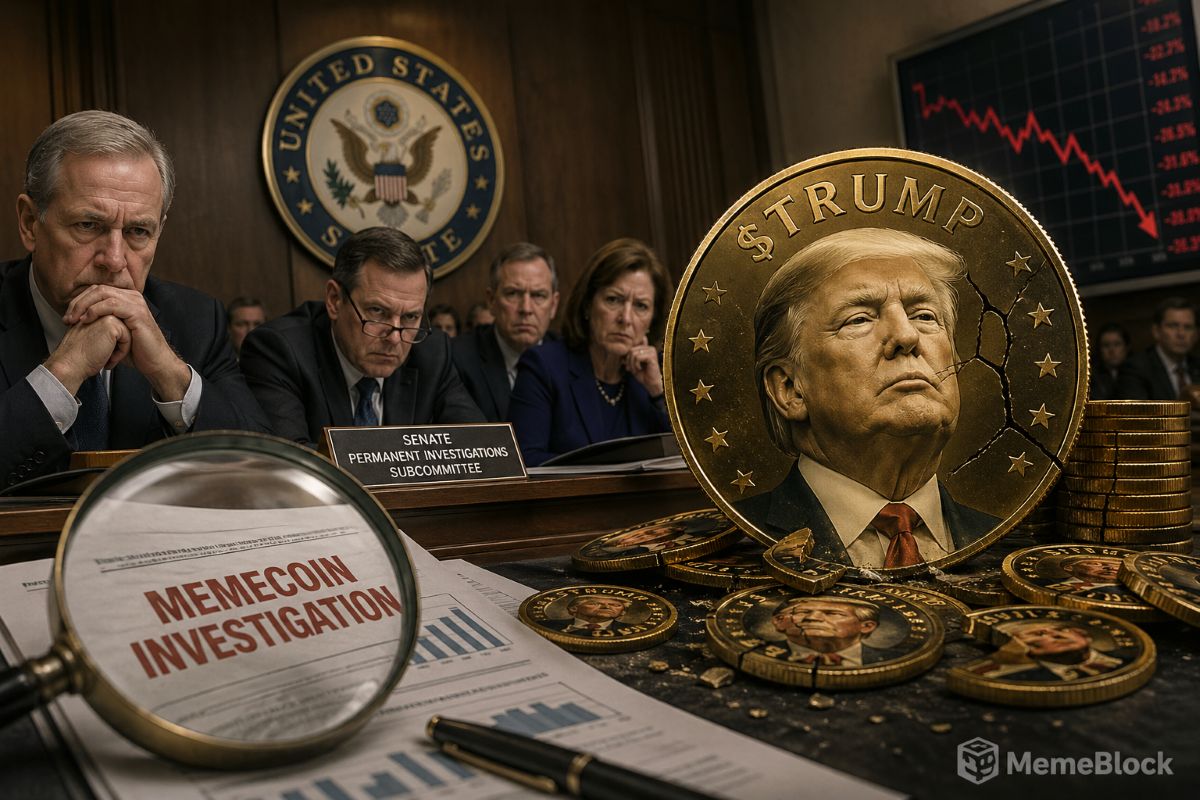
A brewing Washington drama over World Liberty Financial’s $WLFI governance token has turned into one of the most consequential regulatory confrontations of 2025. Democratic Senators Elizabeth Warren and Jack Reed have formally urged federal investigators to examine whether token sales connected to the Trump family’s World Liberty Financial reached wallets linked to sanctioned actors in North Korea and Russia, a charge that raises thorny questions about corporate governance, sanctions compliance, and political conflicts of interest.
The senators’ letter, an explicit request for inquiries by the Department of Justice and Treasury, cites a watchdog report alleging that WLFI distributions included wallets tied to groups of concern. If true, the implications are stark: governance tokens that confer voting power over a financial platform could enable foreign adversaries to exert influence inside an ecosystem that markets itself as a bridge between decentralized finance and traditional banking. That prospect has escalated the issue from a partisan argument to a potential national-security risk.
This controversy doesn’t exist in a vacuum. Investigative reporting earlier in October outlined how crypto ventures affiliated with the Trump family generated large sums in 2025, intensifying scrutiny about whether private financial interests have been too tightly interwoven with public office and policy decisions. Critics argue that the emergence of a high-profile governance token like WLFI, promoted as a way for users to vote on platform policy, requires robust Know-Your-Customer (KYC) controls and sanctions screening that, by many accounts, may not have kept pace with the token’s rapid distribution.
From a regulatory perspective, the case exposes gaps in how the U.S. treats crypto governance tokens. Unlike equity or bank accounts, token holders can be pseudonymous and global, complicating enforcement. The senators’ letter asks for documentation on due diligence procedures and whether entities tied to sanctioned regimes could have acquired voting power, a legitimate concern for lawmakers balancing innovation against national-security safeguards.
The political angle makes this more combustible. WLFI’s backers have pushed an image of mainstream adoption; it ranks among active tokens on price sites and enjoys broad media attention, while opponents frame the token’s international sales as evidence of inadequate oversight and a conflict of interest given the Trump family’s political prominence. Whether the probe will find deliberate wrongdoing or merely systemic lapses in compliance, the episode will almost certainly accelerate calls for clearer rules on governance tokens, sanctions screening, and transparency requirements for politically connected financial ventures.
For investors and policymakers alike, the lesson is simple: the promise of crypto’s borderless finance collides with geopolitical reality. Platforms that allow governance by token holders must build enterprise-grade compliance, rigorous sanctions screening, transparent audit trails, and strong KYC/AML, or risk becoming vectors for influence that extend beyond markets into the realm of national security.
FAQs
Q: Who launched the Senate request to investigate WLFI token sales?
A: Senators Elizabeth Warren and Jack Reed publicly asked federal agencies to investigate alleged WLFI token sales to wallets linked to sanctioned actors.
Q: What evidence do lawmakers cite for the probe?
A: The senators referenced a watchdog report alleging that some WLFI token distributions reached wallets connected to North Korea and Russian-linked actors, and they requested documentation on compliance and risks.
Q: Does WLFI give holders voting power?
A: WLFI is promoted as a governance token that can confer voting rights in the platform’s governance structure, heightening concerns if hostile actors hold meaningful stakes.
Q: Could this lead to new crypto regulations?
A: The case increases pressure on regulators to clarify rules around governance tokens, sanctions screening, and transparency, especially where platforms are tied to politically prominent figures.
Q: Where can I read the senators’ letter?
A: The Senate Banking Committee’s letter and related documents are publicly available on the committee’s website.