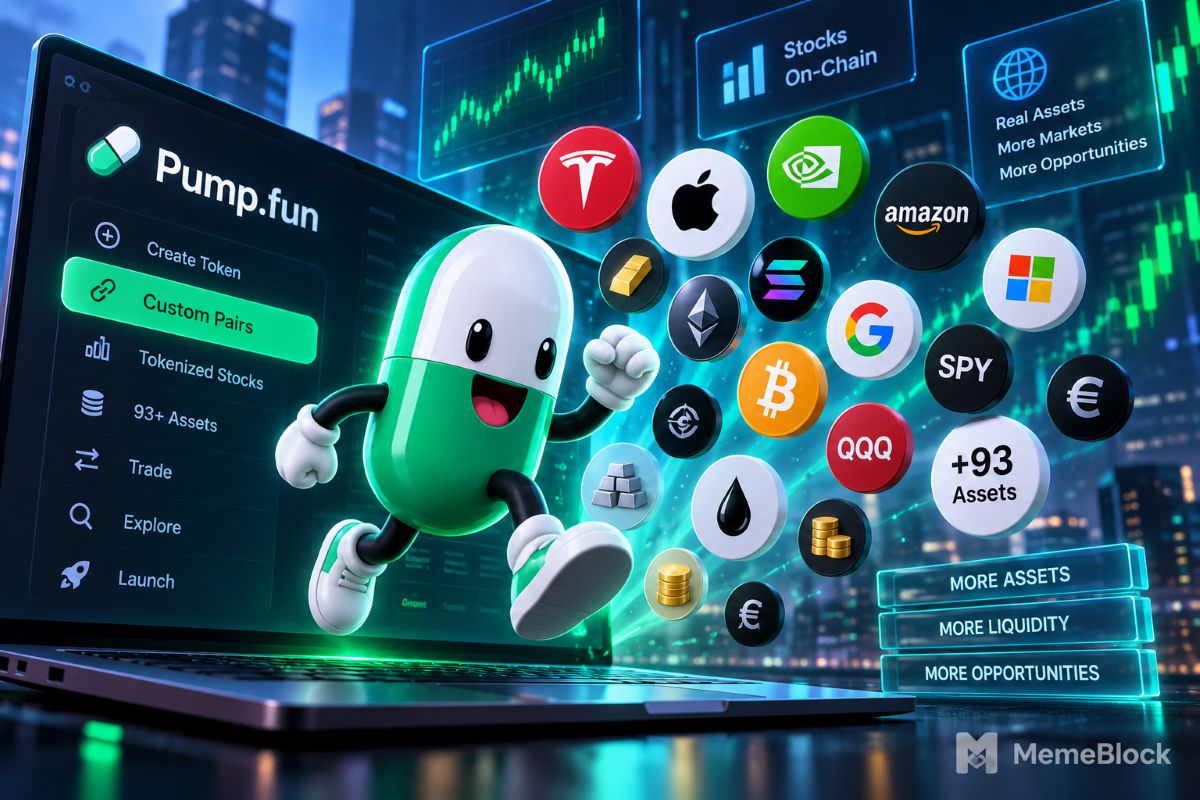
Pump.fun has launched Custom Pairs. This allows creators to launch new tokens against tokenized stocks, major cryptocurrencies, metals and other assets on Solana. Previously, they were limited to SOL and USDC.
Pump.fun announced the feature on Sept. 9, saying creators can select from a broader set of quote assets when launching tokens. Additionally, the platform said the expansion adds 20 new asset pairs through a partnership with Sunrise. This brings the total number of supported asset pairs across Sunrise and xStocks to 93.
The launch extends the role of tokenized real-world assets in Solana’s memecoin infrastructure. It also creates a new revenue mechanism for Pump.fun. The platform says 50% of revenue generated by Custom Pairs will be allocated to its programmatic PUMP buyback-and-burn contract.
Pump.fun Custom Pairs Expand Beyond SOL and USDC
Until the expansion, Pump.fun’s documented paired-token model centered on SOL and USDC. Its fee documentation says USDC became available as a paired asset on May 21, 2026. The platform’s published bonding-curve fee for SOL and USDC markets is 1.25%. This consists of a 0.30% creator fee and a 0.95% protocol fee.
Custom Pairs changes the available quote-asset model. Pump.fun said the new system supports tokenized stocks, major crypto assets, metals and other assets.
The first 20 assets added through Sunrise are BA, BABA, BULL, COST, DELL, DJT, HIMS, IBM, JNJ, LMT, LULU, MGM, PFE, QUBT, RBLX, RDDT, RIVN, SHOP, SNAP and UPS.
Pump.fun said those additions, combined with assets supported through xStocks and Sunrise, bring the total to 93.
The company also said more pairings are planned.
Sunrise and xStocks Supply The New Quote Assets
The expansion connects Pump.fun with two separate tokenized-asset ecosystems.
The 20 newly announced assets are associated with Sunrise and Backpack Securities. Independent coverage from PANews and ChainCatcher reported that the assets are issued through Backpack Securities. They are made available on Solana through Sunrise and Wormhole infrastructure.
Backpack’s own disclosures provide context for how its tokenized securities work. The company says its Solana-based tokenized securities can be redeemed 1:1 for the corresponding underlying securities through Backpack Securities. For example, Backpack says its tokenized Micron and Take-Two products represent redeemable exposure to their respective shares.
That structure is distinct from the broader category of tokenized stocks. In those, the legal rights attached to a token can differ by issuer.
xStocks represents another source of quote assets. Its official website says its tokens are 1:1 backed by underlying U.S. equities and ETFs held in regulated custody. They can trade around the clock across supported blockchain networks.
Pump.fun is therefore not creating the underlying stocks itself. Rather, its Custom Pairs feature allows tokens created on its platform to use existing tokenized assets as quote assets.
Creator Fees Will Be Paid in The Paired Asset
The new system also changes how creators can receive fees.
According to independent reporting on Pump.fun’s Custom Pairs implementation, creators can select a fixed Creator Fee between 0.05% and 1% or choose a Cashback model. Fees are paid in the selected quote asset.
That means the denomination of creator rewards follows the selected pair. For example, a token launched against a tokenized Nvidia asset would distribute applicable creator rewards in that quote asset. Thus, rewards would not automatically be paid in SOL.
Pump.fun has also said that 50% of Custom Pairs revenue will be directed to its programmatic PUMP buyback-and-burn contract.
The distinction between creator fees and protocol revenue matters. The creator-fee mechanism determines what the token issuer receives. Meanwhile, the buyback-and-burn allocation concerns the share of protocol revenue directed toward PUMP.
Pump.fun’s existing public fee documentation, however, had not yet been updated to provide a complete Custom Pairs fee schedule when reviewed for this report. Therefore, the new feature-specific fee mechanics should be checked against the live application and smart contracts before publication.
Tokenized Assets Introduce New Risks Alongside New Liquidity Routes
The expansion gives memecoin creators another way to denominate the economic value of a token. A token paired with a stock-linked asset can potentially make its trading market more directly connected to equity-linked price movements. This is different from a conventional SOL or USDC pair.
That does not mean the newly created token itself represents an equity interest.
The distinction is important because the U.S. Securities and Exchange Commission has said tokenized securities can take different forms. In a January 2026 statement, the SEC’s corporate finance, investment management and trading and markets divisions noted that tokenized securities may be issued by or on behalf of the underlying issuer. Alternatively, they may be issued by unaffiliated third parties, with different structures and holder rights.
For Pump.fun users, that creates several layers of risk. There is the normal volatility and liquidity risk associated with newly launched tokens. There are also separate risks of the selected quote asset, and the legal and structural risks associated with the underlying tokenized asset.
Liquidity is another unresolved issue.
The Defiant reported that, shortly after launch, liquidity varied considerably between available quote assets. In its review of Pump.fun’s pair selector, The Defiant found that some assets had materially deeper liquidity than others. This means the headline count of 93 supported assets does not imply that every pair has comparable market depth.
An independent Terminalpedia review also found a narrower list of quote assets in Pump.fun’s Terminal interface than the 93-asset figure announced by Pump.fun. However, that is not necessarily a contradiction. Pump.fun’s 93 figure covers the assets it says are supported through Sunrise and xStocks, while Terminalpedia was measuring assets surfaced by one particular application interface.
What Readers Should Monitor Next
The most important follow-up is whether Custom Pairs generate sustained trading activity rather than simply increasing the number of available launch configurations.
Editors should monitor the number of tokens actually launched against stock-linked assets, liquidity across the most-used quote assets, graduation rates, trading volume and the amount of protocol revenue ultimately directed to PUMP buybacks.
The relationship between Pump.fun and tokenized-asset issuers also warrants attention. The platform is effectively bringing tokenized equities and other real-world assets into a high-turnover token-launch environment. Meanwhile, the underlying assets can have different issuers, custody arrangements and legal rights.
For now, the verified development is narrower than a claim that Pump.fun has entered the securities market itself. Custom Pairs expands the assets that can be used to quote Pump.fun-created tokens. It does not, based on the available evidence, turn Pump.fun into an issuer of the underlying tokenized stocks.
That distinction should remain central to coverage as the feature rolls out.