Pump.fun is expanding its trading interface into a more social experience, adding features that let users follow traders, receive callouts, participate in communities, communicate through direct messages and trade inside chats. The changes put Pump.fun closer to the product model used by Fomo, a social-first crypto trading app that has built its identity around following traders and sharing market activity.
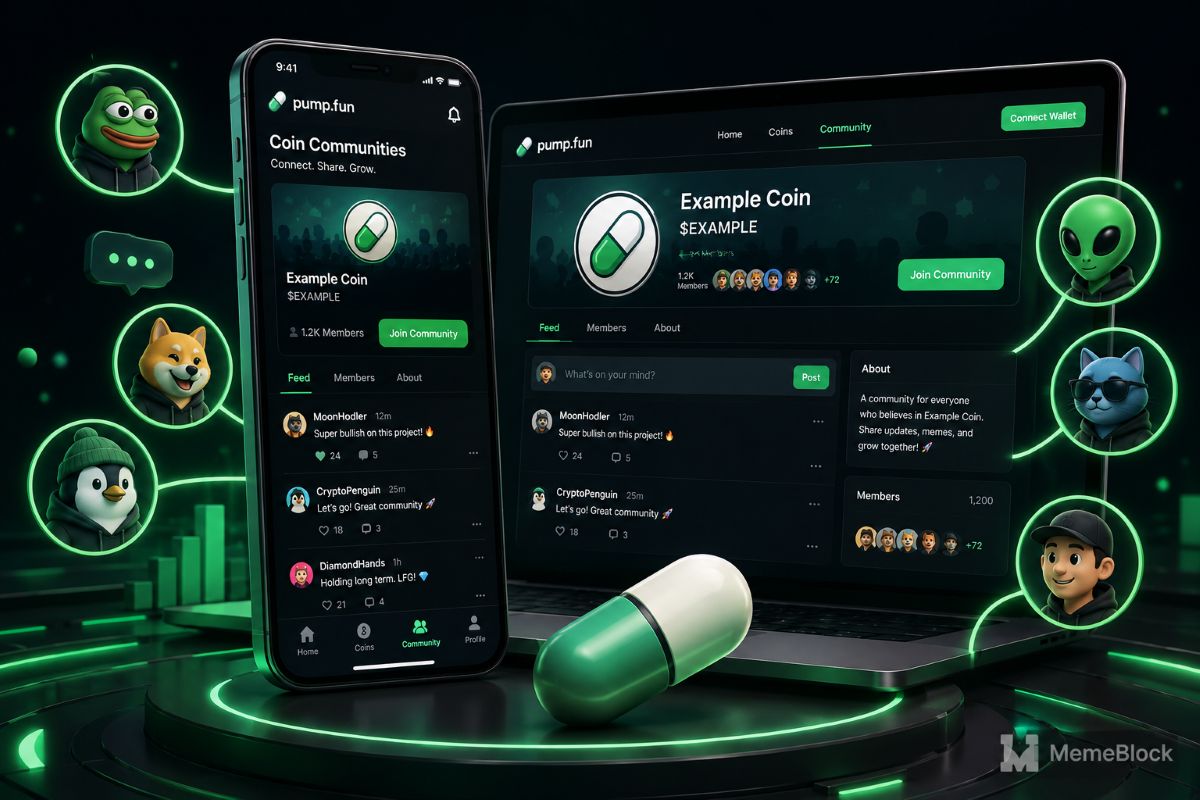
Pump.fun’s current mobile product page explicitly promotes communities, direct messages and the ability to “trade in chat,” while its platform includes a dedicated Callouts section where users can follow top callers and track their calls in real time.
The evidence supports a growing competitive overlap between the two products. There is, however, no public statement from Pump.fun saying that the new features were introduced specifically to counter Fomo.
Pump.fun Moves From Token Discovery Toward Social Trading
Pump.fun historically became synonymous with rapid memecoin creation and early-stage trading on Solana. Its latest app positioning shows a broader attempt to keep discovery, communication and execution inside the same environment.
The company’s current app page highlights real-time alerts for price changes and holders, followed by a social layer built around communities, direct messages and in-chat trading. The platform also allows users to search for coins and users, while its broader interface now exposes tools including Callouts and user profiles.
The Callouts feature is particularly relevant to the social-trading shift. Pump.fun’s dedicated page says users can connect a wallet to follow top callers, track their best calls and watch new callouts arrive in real time.
Pump.fun introduced Callouts publicly in January 2026. Contemporary coverage reported that the feature allowed users to make a call once every six hours, alert followers through push notifications and compete on a global caller leaderboard.
The mobile app’s current Google Play listing also describes a social discovery model in which users can follow top callers, follow friends and compete on a leaderboard. The listing was updated July 10, 2026.
Fomo Established the Social-Trading Template Earlier
The competitive pressure is easier to understand through Fomo’s product development.
Fomo describes itself as an on-chain trading application built around social discovery. Its platform lets users follow friends and traders, view trading activity and interact with trade theses. In February 2026, the company said it had redesigned its social feed and expanded trade theses into its global feed, where users could view, like and interact with traders’ explanations while seeing associated performance information.
Fomo also launched a web version in April 2026. The company said more than 500,000 people had signed up since its mobile launch the previous May and described social functionality as central to the new web experience.
Its expansion has attracted substantial venture backing. Fomo announced a $75 million Series B led by Index Ventures on June 22, 2026, following a $17 million Series A led by Benchmark in November 2025.
Independent coverage has also highlighted the company’s social-trading strategy. TechCrunch reported in November 2025 that Fomo’s $17 million Series A brought its total funding to $19 million at the time and described the company’s focus on consumer-friendly crypto trading.
The Revenue Gap Shows Why Social Features Matter
The competitive question is not simply about interface design. Social trading can influence where users discover assets and where they execute transactions.
DeFiLlama’s latest indexed data shows Pump.fun with approximately $26.19 million in fees over 30 days and $6.96 million over seven days, alongside about $1.50 billion in 30-day decentralized-exchange volume. The same snapshot puts cumulative Pump.fun fees at roughly $1.15 billion.
Fomo has also become a meaningful trading business. DeFiLlama classifies it as a social trading app combining social feeds and copy-trading functionality. Its latest indexed figures show roughly $443 million in 30-day DEX volume.
Solana Compass reported in July that Fomo reached a record $1.39 million in seven-day revenue for the period ending July 16, 2026, placing it ahead of GMGN among trading apps by that particular seven-day revenue measure.
Those numbers should not be read as a direct apples-to-apples comparison. Pump.fun is primarily a launchpad and trading ecosystem, while Fomo operates as a consumer trading application with social and copy-trading functions. Their revenue structures, products and supported assets differ.
Why the Social Layer Could Change Memecoin Trading
For Pump.fun, adding social functionality potentially addresses a fundamental problem in meme coin markets: discovery is increasingly tied to attention.
A trader who sees a token, follows a creator and receives a notification no longer has to leave the platform to discuss the asset before trading it. Moving communication and execution closer together could reduce the friction between social attention and market activity.
There is evidence that social presence matters around Pump.fun launches, although that evidence does not establish that Pump.fun’s new features cause higher token success rates. A July 2026 academic study examining more than 832,000 launches found higher graduation rates among launches advertising social channels, but the study examined external social presence rather than Pump.fun’s new in-app features.
That distinction is important. Social engagement can improve discovery while simultaneously increasing speculative behavior.
Risks Remain Around Copying and Attention-Driven Trading
The same mechanisms that make social trading convenient can amplify risk.
Following a trader does not mean a user receives the same entry price, liquidity conditions or exit opportunity. In fast-moving meme coin markets, a follower may see a call only after an early position has already been established.
Pump.fun itself warns users that prices can move quickly and tells users to trade carefully. Its Google Play disclosures go further, stating that memecoins can be extremely volatile and unpredictable and that the app’s price data may be delayed or inaccurate.
There are also structural concerns around coordinated trading. A separate July 2026 research paper examining 166,098 Pump.fun launches identified recurring groups of early-buying wallets, although its authors cautioned that the observed association did not establish a strong causal case for coordinated manipulation.
For a social trading platform, the distinction between information sharing and herd behavior is therefore material.
What Happens Next
Pump.fun’s next challenge is likely to be less about adding another social feature and more about turning those features into sustained user engagement without compromising trading transparency.
The company already has several pieces of that system: Callouts, followers, user profiles, communities, alerts, messaging and in-chat trading. Fomo, meanwhile, continues to build around social feeds, trade theses, profiles, leaderboards and multichain trading.
The clearest indicators to monitor are user activity, repeat trading, social engagement, trading volume and whether users increasingly complete the full discovery-to-execution cycle inside each platform.
The evidence currently supports describing this as an intensifying product overlap between Pump.fun and Fomo, not as a confirmed direct rivalry declared by either company.