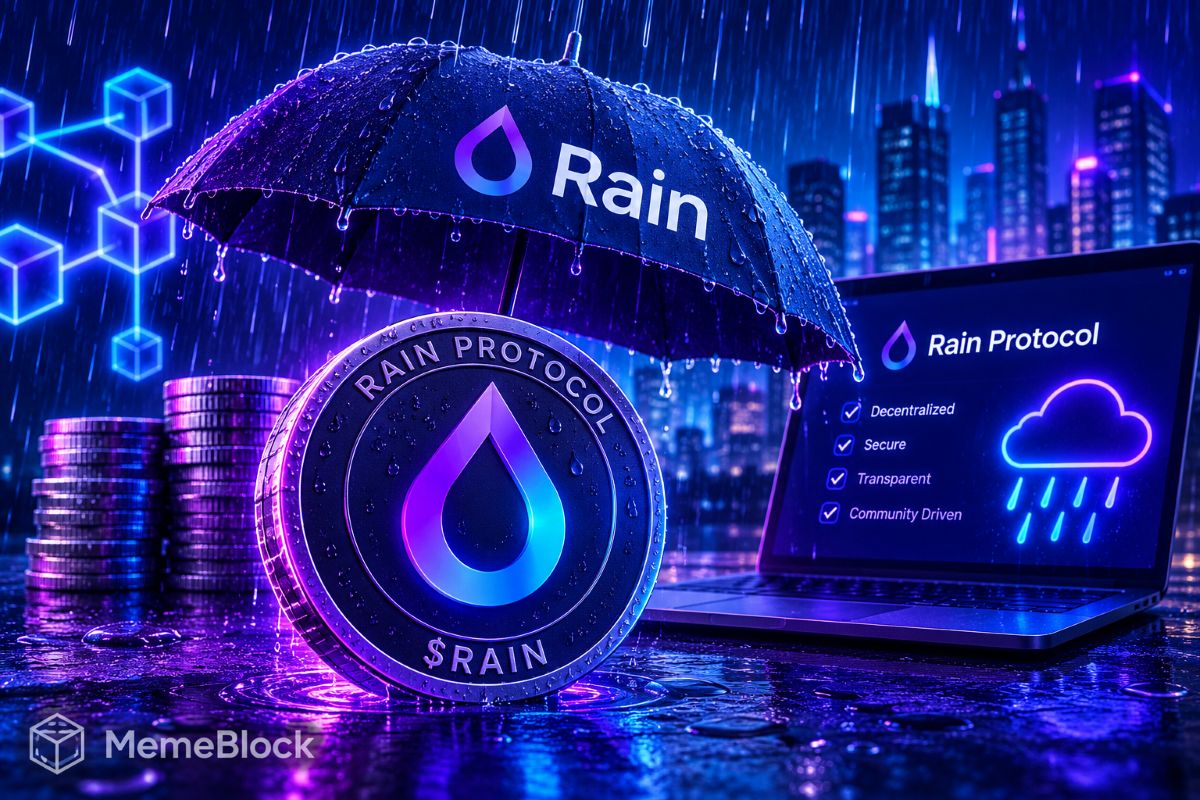
Rain Protocol is an Arbitrum-based decentralized prediction-market infrastructure project. It is designed to let users and developers create, fund and participate in markets tied to verifiable events. The project combines smart contracts, automated market-making, AI-assisted resolution and a native token called RAIN.
For beginners, the most important distinction is that Rain is positioned as infrastructure rather than simply another prediction-market website. Its official documentation says developers can use Rain’s SDKs, APIs and smart contracts to build their own prediction-market applications.
What Is Rain Protocol?
Rain Protocol is built on Arbitrum, an Ethereum Layer-2 network. It focuses on prediction markets where participants assign value to possible outcomes of future events.
A market can contain multiple outcomes, with prices changing according to the amount of liquidity allocated to each outcome. Moreover, Rain describes this as an automated market-maker model. The distribution of funds helps determine the implied probability of an outcome.
The protocol supports both public and private markets. Public markets are open to participants generally, while private markets can be restricted through an access code. Rain says any user can create either type of market.
That permissionless design is one of Rain’s main differences from centralized prediction platforms. Instead of requiring a central operator to approve every new market, Rain’s developer tools are designed to allow applications and users to launch markets around verifiable events.
How Rain Protocol Prediction Markets Work
Creating a market requires defining the question, possible outcomes, timing and initial liquidity. Rain’s current documentation says creators can add liquidity using USDT or RAIN. There is a stated minimum initial liquidity requirement of $10.
Once a market is active, participants trade positions associated with different outcomes. The amount of liquidity behind each outcome affects its displayed probability. As a result, market prices change as participants enter and exit positions.
Resolution is a separate part of the system.
For public markets, Rain says creators can choose manual resolution or an AI-assisted process involving Delphi, an AI-based oracle developed by Olympus AI. The project’s documentation says Delphi uses multiple explorer agents and requires agreement from at least three of five agents before confirming an outcome. Disputed resolutions can then proceed to human review.
Private markets work differently. The creator normally serves as the resolver, although participants can challenge an outcome through the protocol’s dispute process. Rain itself warns that private-market participants need to trust the creator because that person initially controls the resolution.
This resolution architecture matters. Prediction markets are only as reliable as the process used to determine whether an event actually occurred.
What Is the RAIN Token Used For?
RAIN is an ERC-20 token on Arbitrum. Rain’s latest whitepaper identifies it as a governance token and gives a total initial supply of 1.15 trillion tokens. The whitepaper also lists the Arbitrum contract address as 0x25118290e6A5f4139381D072181157035864099d.
However, there is a material documentation discrepancy that beginners should understand.
The whitepaper says RAIN is intended for participation in decentralized governance once the DAO is activated. It also explicitly states that it is not required to trade, deposit or create markets.
Rain’s current help documentation says something different: it describes RAIN as necessary for accessing “Trading Power” and participating in the platform’s prediction markets. CoinDesk’s current RAIN profile likewise describes RAIN holdings as affecting the amount of deposited funds that can be used for positions.
Because these descriptions are not identical, MemeBlock should not present the requirement as an uncontested fact. The safest formulation is that Rain’s current product documentation describes RAIN as part of its trading-access and Trading Power system. Meanwhile, the published whitepaper describes the token’s core function as governance and says it is not required for core market functions.
RAIN also has a fee-linked buyback-and-burn mechanism. Rain’s documentation states that 2.5% of market trading volume is allocated to buying RAIN and permanently burning the purchased tokens.
The protocol says its standard market fee is 5% of trading volume. Its documentation allocates the other portion among market creators, liquidity providers and resolvers.
The token model is not purely deflationary, however. Rain’s documentation says tokens equal to 10% of the amount burned can be minted and allocated through the Foundation. These tokens can be used for areas including ecosystem development, team rewards, marketing, partnerships and community contributors.
That means higher protocol activity does not automatically translate into a permanently shrinking supply at a one-for-one rate.
RAIN Tokenomics and Governance
Rain’s whitepaper sets the initial RAIN supply at 1.15 trillion tokens. It also describes the token as freely transferable on compatible Arbitrum wallets.
The governance structure is still an important area to monitor.
Blockworks’ August 2026 token-transparency filing says the Rain Foundation retains token-administration authority and that Foundation-controlled infrastructure remains involved while the transition toward DAO governance is incomplete. The filing also notes that a first DAO governance vote took place on July 29, 2026.
The same filing says that vote approved a $23 million USDT settlement to acquire locked Credit Refund allocations at $0.0031 per token, with the acquired tokens permanently burned. That transaction is separate from the protocol’s ordinary 2.5% market-volume buyback-and-burn mechanism.
These details are relevant because token governance is not simply a question of whether a DAO exists. The practical issue is how much control token holders have over upgrades, treasury decisions and token administration.
Why Rain Protocol Matters and What Could Go Wrong
Prediction markets have attracted increasing interest because they turn forecasts about events into tradable positions. Rain’s approach attempts to make the underlying infrastructure reusable. This allows third-party builders to create applications, instead of relying exclusively on one front end.
Rain also adds an AI-assisted resolution layer. This can reduce the amount of manual work required to settle markets. However, it creates another dependency: an AI oracle can produce an incorrect or disputed result, meaning the dispute and appeal system remains important.
Smart-contract risk is another limitation. Rain’s published whitepaper warns that the protocol is under active development and that its tokenomics, governance mechanisms and integrations can change. It also identifies oracle, resolution, smart-contract and no-refund risks.
Market liquidity is a separate consideration. A prediction market with limited liquidity can produce prices that are less informative. Such markets can potentially be harder to trade without affecting the market.
There is also conflicting public data about Rain’s current activity. Rain’s own homepage currently displays zero TVL, trading volume, burned RAIN and on-chain transactions. At the same time, DefiLlama currently reports approximately $23.46 million in TVL and identifies Rain as an Arbitrum prediction-market protocol.
That discrepancy should be treated as a data-quality issue rather than resolved by assuming one source is correct.
What Beginners Should Watch Next
The key indicators for Rain are protocol usage, market liquidity, actual trading volume, RAIN supply changes, governance activity and the performance of its resolution infrastructure.
Token supply should receive particular attention because the project combines buybacks and burns with a separate minting mechanism. A headline describing RAIN as simply “deflationary” would therefore omit an important part of the token design.
Readers should also distinguish Rain Protocol from unrelated projects using the RAIN ticker. CoinDesk explicitly notes that other assets with the same ticker exist, including Rain Coin on Polygon and Rainmaker-related assets.
For anyone researching RAIN, the most useful starting point is the project’s official documentation and whitepaper, followed by independent market and disclosure sources. The token’s long-term relevance will depend less on the existence of the ticker itself. More importantly, it will depend on whether Rain develops sustained prediction-market activity, meaningful liquidity, reliable resolution and genuinely decentralized governance.