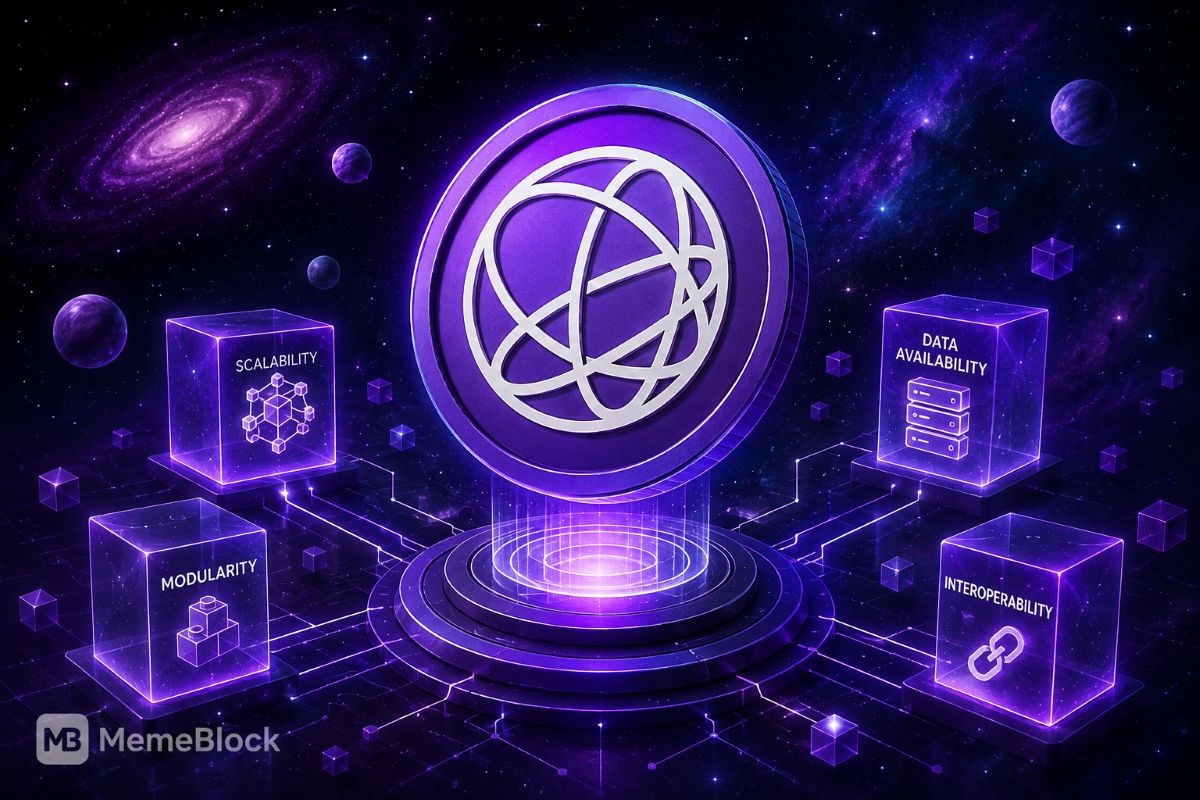
Celestia is a modular blockchain designed primarily to provide data availability. It allows rollups and other blockchain networks to publish transaction data without requiring Celestia itself to execute those transactions. Its native cryptocurrency, TIA, is used for data-availability fees, staking and governance. TIA can also serve as a gas token for new chains.
For readers asking what is Celestia TIA, the simplest explanation is that Celestia specializes in one of the core jobs a blockchain needs to perform. That job is making transaction data available so other networks can verify and reconstruct their state.
Celestia launched its Mainnet Beta on Oct. 31, 2023, marking the project’s move from development into a live modular data-availability network.
What Is Celestia and How Does It Work?
Traditional blockchains generally combine execution, consensus, settlement and data availability in one network. Celestia takes a different approach. It separates data availability and consensus from execution. This allows other networks to use Celestia as infrastructure rather than relying on it to run their applications.
The central technology is data availability sampling (DAS). Instead of requiring every light node to download an entire block, Celestia allows light nodes to randomly sample portions of encoded block data. It then uses cryptographic proofs to determine whether the underlying data is likely available.
Celestia also uses Namespaced Merkle Trees, or NMTs. These allow applications to identify and retrieve data belonging to their particular namespace rather than processing unrelated information in the same block.
This architecture is particularly relevant to rollups. A rollup can execute transactions elsewhere. Meanwhile, it can use Celestia to publish the data needed for users and other participants to verify the rollup’s state.
Celestia’s documentation also provides an integration for the OP Stack. In this integration, rollup transaction data can be submitted to Celestia while commitments are recorded on Ethereum.
What Is TIA Used For?
TIA is more than a tradable cryptocurrency within the Celestia ecosystem.
The first major function is paying for blobspace. Developers publish data through PayForBlobs transactions, with fees denominated in TIA. The fee depends partly on the amount of data being published.
TIA also plays a role in network security. Celestia uses proof-of-stake, meaning holders can delegate TIA to validators and participate indirectly in securing consensus. TIA holders can also participate in governance over certain network parameters.
A further use is bootstrapping new chains. Celestia says developers can initially use TIA as a gas token and currency for a new blockchain. This allows teams to avoid issuing a separate token immediately.
That distinction is important: Celestia is not simply a blockchain whose primary purpose is transferring TIA. The token is tied to the network’s infrastructure functions.
TIA Tokenomics and Supply Explained
Celestia’s genesis supply was 1 billion TIA. The initial allocation covered public distribution, research and ecosystem development, early backers and core contributors.
The original token model called for inflation beginning at 8% annually and declining over time. However, the live network’s inflation schedule has subsequently changed through protocol upgrades.
According to Celestia’s current documentation, the July 2025 Lotus upgrade reduced inflation from approximately 7.2% to about 5%. The November 2025 v6 upgrade then reduced it again to approximately 2.5%. The rate is scheduled to continue declining toward a 1.5% long-term floor.
Token unlocks are another factor investors and users need to understand. Celestia’s genesis allocation included locked portions for contributors, investors and ecosystem development, with different categories following different release schedules. The project states that staking rewards are unlocked when received and can therefore add to circulating supply.
This makes circulating supply different from the original 1 billion TIA genesis figure. Market-data providers therefore can report a larger total supply as additional tokens are issued through inflation and become available.
Why Celestia Matters for Rollups
Celestia’s proposition is closely linked to the growth of modular blockchain infrastructure.
Rollups can move execution away from a base data-availability layer while still publishing information necessary to verify their activity. This can allow developers to specialize different parts of a blockchain stack instead of building every function into one chain.
The concept has attracted competition. Ethereum introduced blob transactions through its Dencun upgrade. Meanwhile, projects including Celestia, EigenDA and Avail have developed alternative data-availability infrastructure. Independent coverage has therefore treated Celestia’s position as part of a broader competition over blockchain data availability rather than an isolated technology category.
Celestia’s own ecosystem has also evolved since launch. In September 2024, the Celestia Foundation said developers had deployed the first 20 rollup chains using the network.
There is an important caveat, however. Data posted to a data-availability network should not automatically be confused with permanent archival storage. Celestia’s documentation explicitly distinguishes availability from historical data retrievability and notes that light nodes can prune older data.
Celestia’s 2026 Roadmap and the Fibre Proposal
One of Celestia’s most ambitious recent developments is Fibre, introduced by the project in January 2026.
Celestia said Fibre achieved a 1 terabit-per-second throughput benchmark across a large test environment and described it as a new data-availability protocol operating alongside Celestia’s existing L1 blockspace. The project’s own figures come from a benchmark involving hundreds of Google Cloud machines, so they should be treated as test results rather than evidence of equivalent sustained production throughput on mainnet.
The distinction matters for beginners. A laboratory or test-network throughput benchmark is not the same thing as demonstrated real-world network usage, economic demand or long-term reliability.
Celestia said Fibre would initially undergo further testing before a gradual mainnet rollout. As of the project’s January announcement, the technology was therefore part of its development roadmap rather than a basis for claiming that 1 Tbps was already the normal production capacity of Celestia’s main network.
Risks and Limitations to Watch
Celestia’s modular architecture does not eliminate the technical and economic risks associated with blockchain infrastructure.
First, competition is intense. Ethereum continues to provide data availability for a large rollup ecosystem, while alternative systems such as EigenDA and Avail compete for developers and data workloads.
Second, network usage matters. A high-throughput DA network needs sustained demand from applications and rollups, not merely impressive technical benchmarks.
Third, TIA has ongoing issuance. Although inflation has been reduced substantially from its original schedule, supply growth and remaining unlocks remain relevant to token economics.
Finally, users should distinguish data availability from permanent data storage. Celestia itself states that historical retrieval requires additional storage providers or infrastructure and is not automatically guaranteed by the DA layer.
What Happens Next for Celestia?
The key developments to monitor are the adoption of Celestia by rollups and appchains, actual blob demand, changes in TIA issuance, and the progression of Fibre from testing toward production deployment.
For beginners, the central idea is straightforward: Celestia is attempting to make blockchain data availability a specialized infrastructure service. TIA is the asset that connects that infrastructure to fees, staking and governance.
Whether that model captures substantial long-term demand will depend less on the concept itself and more on whether developers continue choosing Celestia as blockchain workloads expand.