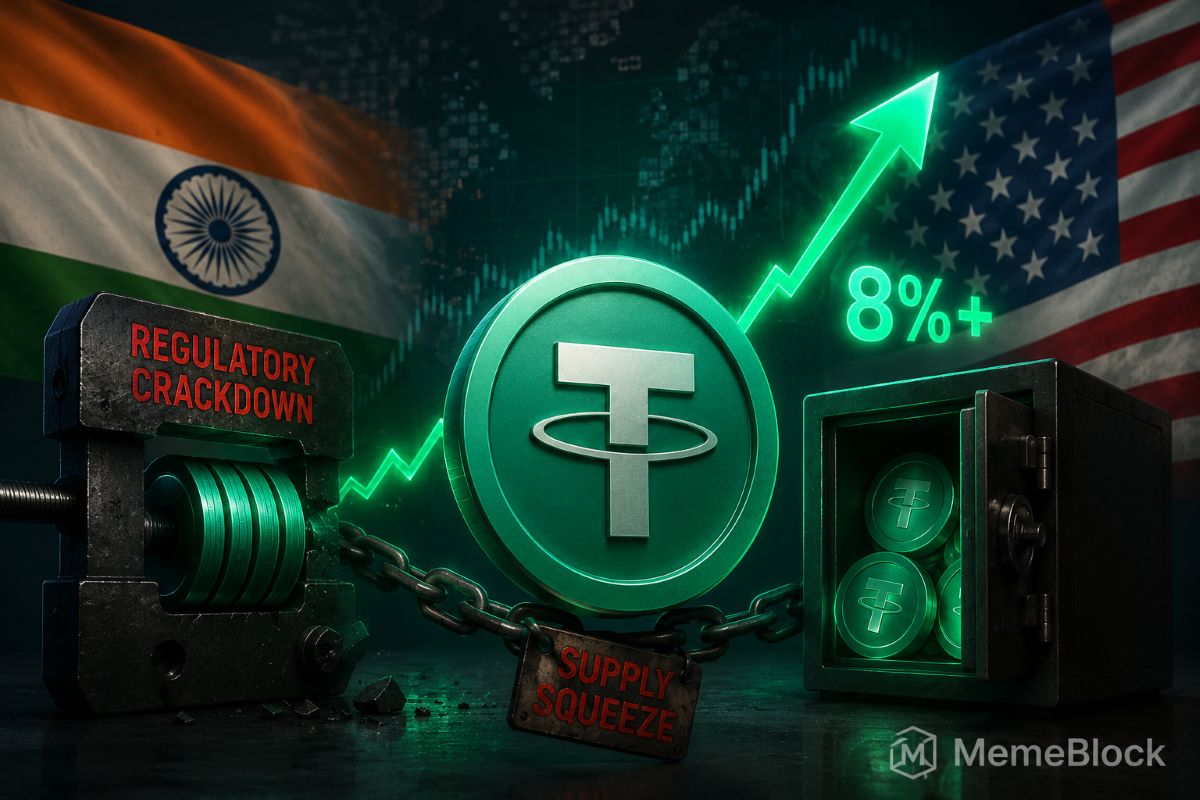
India’s cryptocurrency market is witnessing a sharp rise in the price of Tether (USDT). This is happening as tighter regulatory enforcement disrupts the local supply of the world’s largest stablecoin. The premium on USDT has climbed beyond 8.5%, more than double its usual 3%–4% range. This highlights growing demand amid limited availability.
The sudden jump follows enforcement measures targeting crypto payment operators allegedly involved in unauthorized cross-border transactions. As a result, traders and businesses relying on USDT are now paying significantly more than the official dollar-to-rupee exchange rate. Therefore, this signals increasing pressure across India’s digital asset ecosystem.
Regulatory Crackdown Triggers Stablecoin Supply Shortage
The latest surge in India’s USDT premium comes after the Enforcement Directorate (ED) conducted raids on multiple crypto payment firms in Bengaluru. These actions were part of the Foreign Exchange Management Act (FEMA) investigation.
Authorities allege that five crypto payment companies facilitated more than ₹2,500 crore (approximately $265 million) in unauthorized overseas transfers using virtual digital assets. The investigation has disrupted one of the key channels. Through these channels, USDT entered the Indian crypto market.
With fewer stablecoins circulating domestically, buyers have been forced to pay a much higher premium to secure USDT for trading, remittances, and decentralized finance (DeFi) activities.
According to market data reported by local financial media, USDT recently traded around ₹102.88. At the same time, the interbank USD-INR exchange rate remained near ₹94.65. This created one of the widest pricing gaps seen in recent years.
Why India’s USDT Premium Is Rising
India has historically traded USDT at a premium because of strong demand and limited fiat on-ramps. However, the current situation represents a significant supply shock.
Several factors are contributing to the widening premium:
- Reduced availability of USDT following enforcement actions.
- Continued demand from traders seeking a stable digital dollar.
- Limited arbitrage opportunities due to capital controls.
- Stricter anti-money laundering (AML) compliance requirements.
- Ongoing tax regulations affecting crypto transactions.
Unlike global markets, where arbitrage quickly eliminates pricing differences, India’s regulatory framework often slows the movement of capital. As a result, premiums can remain elevated for extended periods.
Impact on Traders and Crypto Businesses
The supply shortage is already affecting several participants across the crypto ecosystem.
Retail investors purchasing USDT now face higher entry costs before they can trade Bitcoin, Ethereum, or other cryptocurrencies. Professional traders also see reduced profitability as wider premiums increase transaction expenses.
Businesses using stablecoins for international settlements may encounter higher operational costs. Meanwhile, decentralized finance users could experience lower liquidity across trading platforms.
At the same time, exchanges operating within India’s regulatory framework may witness lower trading volumes. This may happen if elevated premiums discourage new market participants.
Regulatory Oversight Continues to Expand
India has steadily increased oversight of the digital asset industry over the past few years. Authorities have introduced stricter Know Your Customer (KYC) standards and enhanced anti-money laundering checks. They have also imposed tougher tax reporting obligations for crypto transactions.
Recent enforcement efforts indicate that regulators remain focused on preventing the use of cryptocurrencies for unauthorized cross-border fund transfers.
Industry observers believe these actions could encourage greater compliance among crypto businesses. Additionally, they could reshape how stablecoins circulate within India’s digital asset market.
Although the government’s long-term regulatory framework continues to evolve, enforcement activity suggests authorities are prioritizing transparency and financial monitoring. This is happening over unrestricted crypto adoption.
What Happens Next?
The future direction of India’s USDT premium will largely depend on whether domestic liquidity improves.
If compliant market participants restore stablecoin inflows, the premium could gradually return to historical levels. However, continued enforcement activity or additional restrictions may keep supply constrained for longer.
For now, traders should closely monitor regulatory developments, liquidity conditions, and exchange pricing before executing large stablecoin transactions.
As India continues balancing innovation with financial oversight, the recent surge in USDT premiums demonstrates how regulatory actions can rapidly influence digital asset pricing and market dynamics.