
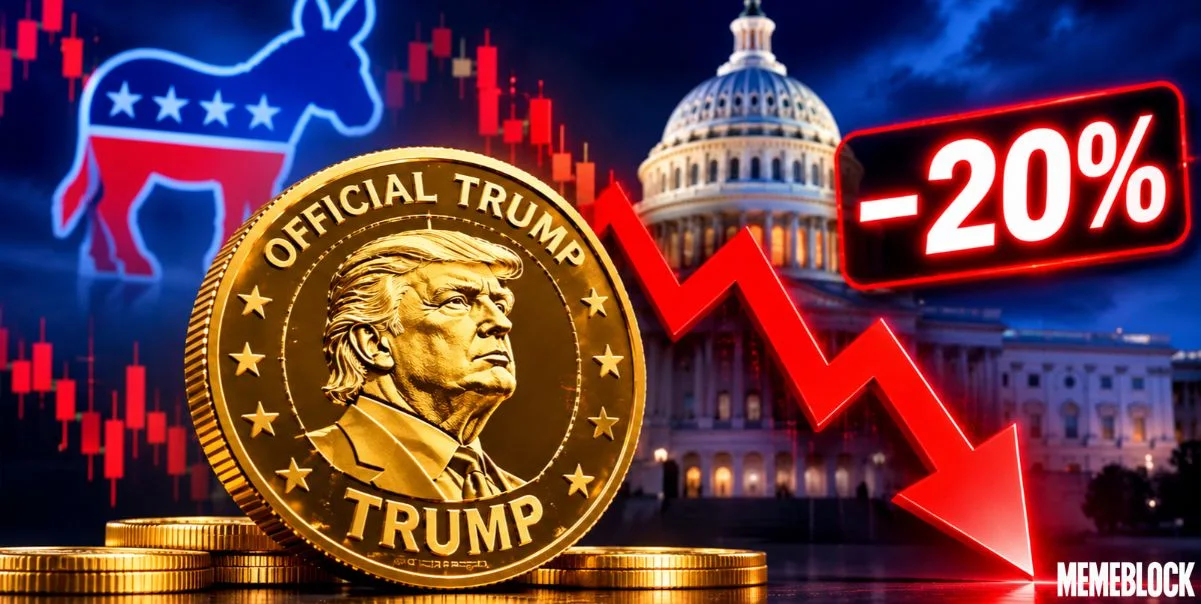
The Official Trump ($TRUMP) meme coin suffered a sharp sell-off on November 4, falling to approximately $1.22 and recording an intraday decline of more than 20% as Democrats secured control of both chambers of the US Congress in the November 3 midterm elections. The drop placed the politically branded token among the market's weaker large-cap cryptocurrencies during a session in which much of the wider digital-asset market recovered.
Official Trump (TRUMP) is a meme coin launched on the Solana blockchain and associated with Donald Trump. Separately, World Liberty Financial (WLF) is a Trump-linked crypto project whose official website lists integrations with Ethereum, BNB Smart Chain and Solana. These are separate crypto projects and should not be confused.
The price movement arrived as investors assessed the implications of a major political shift in Washington. Democrats are preparing to use their new congressional power to scrutinize President Donald Trump's administration and business interests. Several Democratic lawmakers had already called for hearings into the president's cryptocurrency holdings, while reporting before and after the election identified Trump-linked crypto ventures as potential subjects of oversight.
The timing has placed the $TRUMP token and the wider Trump crypto ecosystem under renewed attention. However, the market decline should not be treated as proof that an investigation has begun or that political scrutiny alone caused the entire sell-off. The available evidence establishes that the token fell during the same period as the election result and renewed discussion of congressional oversight. It does not isolate the contribution of each market catalyst.
$TRUMP Price Falls More Than 20% During the November 4 Sell-Off
Market data published on November 4 showed the Official Trump token trading near $1.22, down approximately 22.56% over the preceding 24 hours in a report by TheStreet. The decline followed the Democratic victories in the midterm elections and came as investors reassessed the outlook for businesses and digital assets associated with the president.
Historical data from Scrypt Price provides additional detail on the November 4 trading session. It recorded an opening price of approximately $1.5867, an intraday high of $1.5872 and a low of $1.2227. The difference between the opening level and the intraday low represents a decline of roughly 23%. The same dataset recorded approximately $65.78 million in trading volume for the daily session.
Other market-data providers recorded different daily closing prices and percentage changes. Investing.com listed a November 4 close of approximately $1.287, compared with an opening price of $1.587, and a daily change of around 18.88% lower. It reported daily trading volume of approximately $58.45 million. The difference reflects distinct data aggregation and daily-candle methodologies. An intraday fall from the opening price should not be confused with a full-day closing return or a rolling 24-hour percentage.
TheStreet's reported $1.22 price and 22.56% 24-hour decline therefore describe a market snapshot, while historical daily records show the range and the closing performance over a calendar session. Both support the conclusion that $TRUMP experienced a sharp sell-off, but they are not interchangeable measurements.
The market context is important. CoinDesk reported that several major cryptocurrencies recovered during the November 4 session, while Trump-linked tokens continued to lag. Its market update recorded the Official Trump token down approximately 7.1% and World Liberty Financial's WLFI token down around 5% at the time of its report. Those figures cover a different snapshot and reporting window from the earlier 20%-plus $TRUMP decline.
CoinMarketCap's post-election coverage also reported that more than 80 of the 100 largest cryptocurrencies rose over 24 hours on Wednesday, while $TRUMP fell by about 21% and WLFI reached a record low. The divergence suggests that the sell-off was not simply a reflection of every major cryptocurrency moving lower at the same time.
Why Did the Political Shift Put $TRUMP Under Pressure?
The November 3 midterm elections changed the balance of power in Washington. The Associated Press reported that Democrats won control of both the House of Representatives and the Senate, ending unified Republican control of Congress during Trump's second presidency.
The results were consequential for the president's legislative agenda. A Democratic majority can control congressional committees, schedule hearings, issue subpoenas through appropriate committee processes and conduct oversight of the executive branch. It can also make it more difficult for the administration to advance legislation without bipartisan support.
For cryptocurrency markets, the political shift creates uncertainty around the future of legislation and regulation. The Trump administration has pursued a more supportive approach to the digital-asset industry than the previous administration. A Congress controlled by Democrats could place greater emphasis on consumer protection, conflicts of interest, financial disclosures and the relationship between government policy and private crypto businesses.
The issue is particularly sensitive for $TRUMP because its market identity is closely connected to the president's public profile. Unlike a token whose demand is primarily tied to a technical network or a widely used application, a politically branded meme coin can be affected by changes in public perception, media attention and the political fortunes of the person whose identity it uses.
That connection can work in both directions. Positive political developments, public appearances and strong online engagement may support attention and speculative demand. Negative headlines, controversy or concerns about the associated political figure can have the opposite effect. This does not mean every price movement is politically driven, but it helps explain why investors may react to Washington developments more sharply than they would to an unrelated policy announcement.
Democrats Have Already Called for Scrutiny of Trump's Crypto Holdings
Democratic interest in Trump's cryptocurrency ventures did not begin with the election result. In a July 10, 2026 statement published by the Senate Banking Committee's Democratic members, five senior Democratic lawmakers called for committee hearings to examine the national security implications of the president's cryptocurrency holdings.
The statement was issued by Senators Elizabeth Warren, Richard Blumenthal, Gary Peters, Dick Durbin and Ron Wyden. The lawmakers raised concerns about Trump's financial disclosures, the reported involvement of unidentified third parties in World Liberty Financial and the possibility that foreign interests could influence presidential decisions through business relationships.
The senators specifically called for hearings to investigate the national security implications of Trump's cryptocurrency holdings, including possible influence from the United Arab Emirates or other unidentified third parties. Their statement also questioned whether the president's financial interests could affect his approach to cryptocurrency legislation and regulatory enforcement.
This is a documented political position, not evidence that a new congressional investigation has already been opened. The July statement called for hearings. It did not establish that investigators had completed a formal inquiry, issued findings or determined that any law had been violated.
Before the midterms, Bloomberg Government also reported that Democratic lawmakers on key House and Senate committees were preparing to increase scrutiny of Trump's crypto connections if they gained control of Congress. The report described interviews with lawmakers and outlined how committee leadership could shift the focus from advancing crypto legislation toward oversight of the president's business interests.
Following the election, Bloomberg Government reported that Democrats' new congressional position could bring further attention to the president's crypto dealings. Elizabeth Warren is expected to take a leading role on the Senate Banking Committee, while Democratic lawmakers have identified oversight hearings as a priority.
The political direction is therefore clear: Democratic lawmakers have publicly expressed interest in examining Trump's crypto interests, and their election victory gives them greater institutional capacity to pursue that agenda. The precise scope, timing and legal outcome of any future inquiry remain unsettled.
Which Trump-Linked Crypto Ventures Could Face Greater Attention?
The discussion extends beyond the $TRUMP meme coin. Two distinct crypto ventures are central to the political debate: the Official Trump token and World Liberty Financial.
The Official Trump token was launched in January 2025 and became one of the most visible examples of a cryptocurrency built around a sitting president's public identity. Its appeal is closely connected to the Trump brand, online political culture and speculative trading. Its price can therefore be exposed to shifts in political sentiment even when there is no direct change to the token's underlying technical operation.
World Liberty Financial is a separate Trump-family-associated crypto business. It has developed a broader decentralized-finance ecosystem and offers the WLFI governance token. Its official website describes WLFI as a token through which holders can participate in platform governance, including proposals and votes. The project's products also include USD1, a dollar-linked stablecoin.
World Liberty Financial is especially relevant to lawmakers' stated concerns because the July Senate Democratic statement specifically referred to the company's ownership and reported foreign investment questions. The senators highlighted reports of a 49% stake in the venture being purchased by an entity connected to the United Arab Emirates and questioned whether foreign interests could create national security concerns.
The company's own disclosures also provide important context. Its website states that an entity affiliated with Donald Trump and certain family members owns approximately 38% of the equity interests in WLF Holdco LLC, which holds the membership interest in World Liberty Financial LLC. The website also describes the family's holdings of WLFI tokens and the contractual arrangements through which affiliated entities may receive fees.
These disclosures do not by themselves establish wrongdoing. They do, however, help explain why lawmakers have focused on financial relationships, ownership structures, token sales and the potential intersection between private business interests and public policy.
The two tokens should not be treated as identical assets. $TRUMP is a politically branded meme coin, while WLFI is presented by its issuer as a governance token connected to a decentralized-finance platform. Their market prices may react to the same political news, but their stated functions and business structures differ.
Could Congressional Scrutiny Change Investor Confidence?
The possibility of hearings and investigations can influence investor confidence before any formal proceeding begins. Markets often respond to uncertainty about future regulation, reputational risk and the possibility that a business could face demands for documents, testimony or changes to its operations.
For $TRUMP, the political connection is central to the asset's identity. If the token's appeal depends partly on the perception that the president remains politically influential, a shift in congressional power may affect how some traders value that association. Investors may also become more cautious if negative headlines make the token a focal point of public controversy.
There are several possible channels through which scrutiny could affect the market. First, hearings could increase media attention and keep questions about the token's distribution, economics and relationship to Trump's wider business interests in the public conversation. Second, scrutiny of World Liberty Financial could create uncertainty around the broader Trump-linked crypto ecosystem, even though WLFI and $TRUMP are separate assets. Third, the prospect of tighter oversight could influence expectations about the administration's ability to advance crypto-friendly legislation.
These are possible transmission channels, not confirmed outcomes. A congressional hearing does not automatically result in enforcement action, a legal violation or a change to token operations. The impact would depend on what lawmakers examine, what evidence emerges and whether any official action follows.
The market's reaction also cannot be reduced to political sentiment alone. Meme coins are volatile assets, and their prices can move because of liquidity conditions, derivatives positioning, large-holder transactions, broader risk appetite and changes in speculative demand. The November 4 sell-off occurred amid several market developments, including broader uncertainty around digital assets and security concerns following a major crypto exchange incident reported during the same week.
The available market reporting indicates that $TRUMP underperformed many other large cryptocurrencies during the post-election session. That relative weakness is consistent with a political repricing interpretation, but it does not prove that the election result was the only cause.
What Does the Sell-Off Reveal About Meme Coin Culture?
The $TRUMP episode highlights a defining feature of political meme coins: the token can function as both a tradable asset and a symbol of participation in an online political community.
Meme coin markets are built around attention, identity and collective narratives. Holders may buy because they support a public figure, enjoy the associated internet culture, expect future attention or simply anticipate a price increase. Those motivations can overlap, but they are not the same as a claim on a company's earnings or a conventional financial interest.
Political meme coins are particularly exposed to changes in the public image of the person they reference. An election result can alter the perceived strength of a political brand, while congressional scrutiny can turn the token into a symbol of a wider debate about ethics, influence and financial conflicts.
That creates a difficult balance for community sentiment. Supporters may interpret political criticism as a reason to defend the project and increase online engagement. Other holders may see the same developments as a warning that the token's market narrative has become more vulnerable. Without a reliable, representative dataset of public posts or holder sentiment, it is not possible to quantify which reaction is dominant.
The market's price action provides one observable signal: traders sold $TRUMP heavily during the post-election period, while the token's price and trading volume showed a substantial change. But a price chart cannot reveal whether those sellers were long-term supporters, short-term speculators, market makers or investors reacting to unrelated financial conditions.
The broader lesson is that political association can create attention, but it can also create concentrated reputational and regulatory exposure. A meme coin whose narrative is tied to a political figure may experience sudden changes in demand when that figure's political circumstances change.
What Happens Next for $TRUMP and Trump's Crypto Ventures?
The next important developments are likely to come from Washington and from the market's response to further political headlines. Congressional Democrats have the opportunity to set committee priorities, request documents, hold hearings and examine the relationship between Trump's crypto interests and public policy.
The July 2026 Senate Democratic statement provides a clear record of the issues some lawmakers want examined. World Liberty Financial's reported ownership and foreign investment questions are among the specific subjects already raised. Bloomberg Government's reporting after the midterms indicates that oversight of Trump-linked crypto deals is likely to become a more prominent part of the new Congress's agenda.
However, as of November 5, the available public evidence does not establish that a new formal congressional investigation specifically targeting the $TRUMP token or World Liberty Financial has officially commenced. The distinction matters: political intent, a call for hearings, a committee inquiry and a formal investigation are different stages of congressional oversight.
For traders, the immediate question is whether the token can stabilize after the sharp November 4 decline or whether political uncertainty will continue to weigh on demand. A sustained recovery would require more than a change in headlines; it would depend on trading activity, liquidity and the willingness of buyers to return to a highly speculative asset.
For the wider meme coin community, the episode is a reminder that tokens built around public figures do not operate outside real-world politics. Their narratives can be shaped by elections, congressional hearings, public disclosures and changing perceptions of influence. The $TRUMP sell-off demonstrates how quickly those external developments can become part of a token's market story.
The political story is still developing. The market decline is measurable, the election result is confirmed and Democratic lawmakers have documented their interest in examining Trump's crypto interests. What remains unknown is whether that scrutiny will produce formal proceedings, what evidence those proceedings might uncover and how investors will respond as the political and regulatory picture becomes clearer.
Evidence Limitations
1. Confirmed Facts
The Official Trump token experienced a sharp decline on November 4, 2026. TheStreet reported a price near $1.22 and a 24-hour decline of approximately 22.56%. Historical market data separately recorded an intraday low near $1.2227. The Associated Press reported that Democrats won control of both chambers of Congress in the November 3 midterm elections.
On July 10, 2026, five senior Senate Democrats publicly called for hearings to investigate the national security implications of President Trump's cryptocurrency holdings. Their statement specifically raised questions about World Liberty Financial and possible foreign or third-party influence.
World Liberty Financial's official website describes WLFI as a governance token and publishes disclosures about ownership and affiliated entities. The website identifies an entity affiliated with Donald Trump and certain family members as holding approximately 38% of the equity interests in WLF Holdco LLC.
2. Source Attribution and Measurement Differences
The reported $1.22 price and 22.56% 24-hour decline come from TheStreet's November 4 market report. Scrypt Price's historical dataset recorded a November 4 opening price of approximately $1.5867, an intraday low of approximately $1.2227 and daily volume of approximately $65.78 million.
Investing.com reported a November 4 closing price of approximately $1.287, a daily decline of approximately 18.88% and volume of approximately $58.45 million. These figures use different market-data aggregation and candle methodologies. The article does not combine them into one purportedly exact price series.
CoinDesk's November 4 report recorded a smaller decline in a later market snapshot. The percentage change therefore depends on the precise timestamp and reporting window.
The election result is attributed to Associated Press reporting. The lawmakers' stated position is attributed to the official Senate Banking Committee statement. The company's description of its products and ownership disclosures is attributed to World Liberty Financial's official website.
3. Unverified Claims and Estimates
The claim that political scrutiny was the sole or direct cause of the entire $TRUMP decline is not established. The timing of the sell-off and election result supports a possible connection, but available data cannot isolate the effect of the election from liquidity, speculative positioning, broader market conditions or other news.
The potential impact of future congressional hearings on token prices is an interpretation, not a confirmed forecast. Any future regulatory or legal consequences remain uncertain.
4. Unknown Information
The available sources do not establish the identity or motivations of the traders responsible for the November 4 selling. They do not provide a complete breakdown of exchange-level flows, large-holder transactions or the proportion of volume attributable to retail versus institutional participants.
There is no representative, independently verified dataset in the cited sources measuring the $TRUMP community's sentiment after the election. Individual social media posts, where encountered, would not establish the views of the wider holder community.
As of November 5, the sources reviewed do not confirm that a new formal congressional investigation specifically targeting the $TRUMP token or World Liberty Financial has commenced.
5. On-Chain and Ownership Evidence
This article does not use wallet-level activity to infer the identity, political affiliation or intent of token holders. The existence of a transaction or token balance would not, on its own, establish who controls a wallet or why a transaction occurred.
World Liberty Financial's published ownership disclosures are company statements. They should not be treated as an independent audit of all beneficial ownership, contractual arrangements or third-party interests.
6. Conclusions the Available Evidence Cannot Support
The evidence does not establish that Democrats have already opened a formal investigation into the $TRUMP token or World Liberty Financial. It does not establish that the token's price decline was caused entirely by the election result or by a specific lawmaker's statement.
The available material does not establish that Trump or any associated entity has violated a law. It also does not establish that the token will continue falling, recover to a particular price or face a specific regulatory outcome.
The article therefore treats the market decline, election result and lawmakers' stated oversight intentions as confirmed developments, while presenting their possible effect on investor confidence as analysis rather than proven causation.