
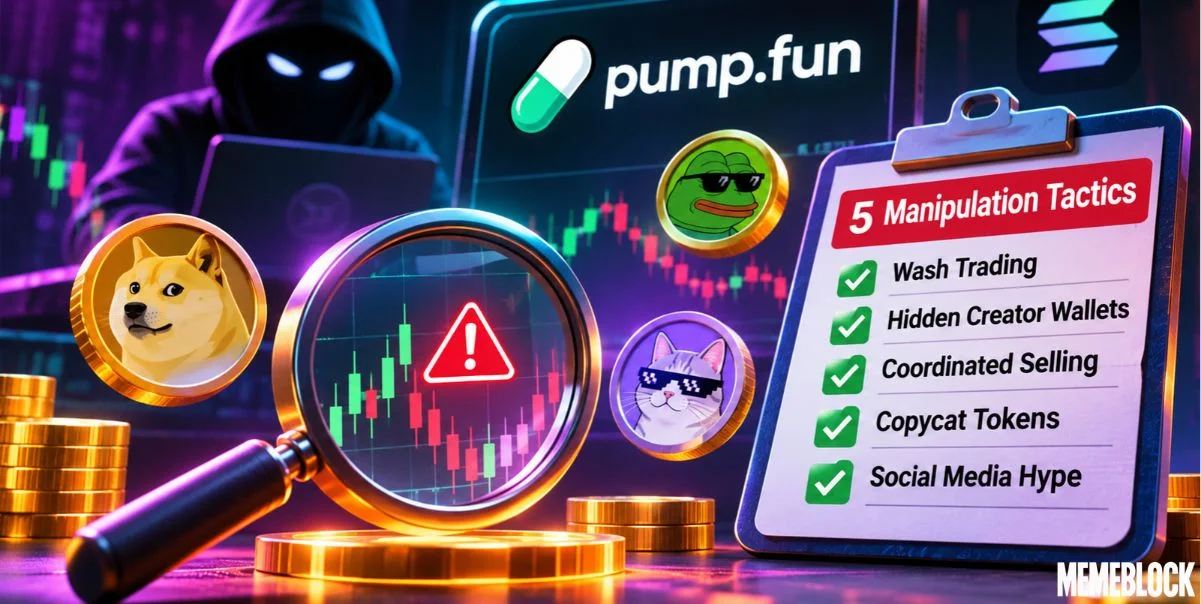
A large-scale study of Pump.fun has identified several ways trading activity and token launches can be manipulated, raising questions about how investors interpret activity on the memecoin launchpad. The research, titled Meme Coin Factories: Uncovering Large-Scale Manipulations on pump.fun, examines token launches and trading behaviour on the Solana-based platform between January 14, 2024, and January 14, 2026.
The researchers analysed metadata covering 15,245,966 tokens. For transaction-level analysis, however, they used selected samples rather than the complete transaction histories of every token. Their findings describe five categories of activity: wash trading, creator address obfuscation, coordinated selling, copycat tokens and social media manipulation.
The distinction between token metadata and sampled transaction data matters. The study provides a broad view of the platform’s token-launch activity, but its transaction-based findings should be understood within the limits of the samples examined.
How the researchers examined Pump.fun
The paper was written by Nicolas Szwajcok, Taro Tsuchiya, Enze Liu, Kyle Soska, Mathias Payer and Nicolas Christin. It combines token-level information with blockchain transaction analysis to investigate patterns that may distort the appearance of demand, trading activity and token distribution.
Rather than treating every launched token as a separate, unrelated project, the researchers also examined relationships between creators, wallets and trading patterns. This helped them identify repeated behaviours that could be difficult to recognise by looking at a token’s price chart alone.
The researchers used a random 1% token sample and an additional five-day transaction sample for parts of their analysis. Together, the analysed transaction data covered more than 87 million transactions. These samples are the basis for several of the paper’s transaction-level estimates; they should not be confused with a complete examination of every transaction involving all 15.2 million tokens.
1. Wash trading can make activity appear stronger
Wash trading involves buying and selling an asset in a way that creates trading activity without necessarily representing independent market demand. In a memecoin market, this can make a token appear more active than it would be if its trades came from unrelated buyers and sellers.
The study identified at least four million transactions associated with wash trading in its analysed samples. The researchers estimated that these transactions represented approximately 17% of trading transactions in those samples.
The paper also reports that wash trading could increase a token’s probability of reaching Pump.fun’s graduation threshold by as much as ten times. Graduation is a platform milestone, not evidence that a token has genuine community support, sustainable liquidity or profitable trading conditions.
For traders, the finding highlights a limitation of using transaction volume as a standalone measure of demand. A token can display frequent buying and selling while the underlying activity may not reflect a broad group of independent participants.
2. Creator address obfuscation makes connections harder to see
A token’s creator address can provide useful information about its launch history. However, a creator who uses multiple addresses or separates activity across wallets can make it harder for observers to identify links between launches.
The researchers examined creator activity and found a concentration of token creation among a relatively small group. According to the paper, the top 1% of creator groups were responsible for 58.6% of tokens in the study’s dataset.
This concentration does not automatically mean that every prolific creator engaged in manipulation. Launching multiple tokens is not, by itself, proof of misconduct. The concern is that fragmented wallet activity can make repeated launches and related trading behaviour harder to assess.
For an investor, a new token should therefore not be evaluated only by its displayed creator address. Wallet relationships and repeated launch patterns may provide additional context, but blockchain links alone cannot establish the real-world identity of the people controlling those wallets.
3. Coordinated selling can expose buyers to sudden exits
A token may attract buyers while several connected or similarly behaving wallets hold substantial positions. If those wallets sell within a short period, the resulting supply can place pressure on the market.
The study identified nearly 8,000 instances classified as coordinated selling across its analysed samples. It reports 4,402 instances in the random 1% sample and another 3,510 in the five-day sample.
These findings point to a risk that may not be obvious from a token’s headline price movement. A chart can show rising activity without revealing whether a small set of wallets holds a large share of the supply or whether multiple wallets are selling in a similar pattern.
However, similar timing does not independently prove that different wallets are controlled by the same person or that their owners agreed to sell together. The research identifies patterns consistent with coordinated activity; conclusions about ownership and intent require evidence beyond transaction timing alone.
4. Copycat tokens can exploit familiar names and branding
Copycat tokens use names, symbols, descriptions or images that resemble existing projects. Their similarity can make it harder for users to distinguish an original token from a newly launched imitation, particularly when many tokens appear in a short period.
The researchers identified at least 1.5 million tokens that met their copycat criteria, representing more than 10% of the tokens examined. Their classification considered similarities in token names, symbols, descriptions and images.
This category is relevant because a familiar-looking token is not necessarily connected to the project it resembles. A similar ticker or image does not establish an official relationship, shared development team or authorised launch.
The study’s classification identifies similarities in token presentation. It does not mean that every token included in the category was created with proven fraudulent intent. Traders still need to verify a token’s contract address and official project channels rather than relying on branding alone.
5. Social media activity can coincide with token launches
Memecoin launches often take place alongside activity on social platforms. A post can draw attention to a name, image or online trend, while a newly created token may use the same subject to attract traders.
The paper reports that approximately 3.5 million tokens, or 23.5% of the tokens in its dataset, were created shortly after posts on Twitter or Truth Social. The researchers also identified 31 posts associated with token creators’ estimated extractable value of at least $1 million per post.
The financial figure requires careful interpretation. It is an estimate derived from the researchers’ analysis, not proof that the creators actually received or realised that amount as profit. It should not be treated as a confirmed record of cash proceeds.
The timing relationship also does not establish that a person who published a social media post deliberately promoted a token or participated in a manipulation scheme. A post may precede a token launch without the poster having any connection to its creator. The study identifies an association that warrants scrutiny, not proof of intent by every account involved.
The rise of manipulation-as-a-service
Beyond individual trading patterns, the researchers describe a wider ecosystem they call Market-Manipulation-as-a-Service (MMaaS). The term refers to third-party services that advertise tools designed to automate or support activities associated with token launches and trading.
The paper examined four services and reviewed features they advertised. These included creating multiple wallets, executing trades with low latency, copying tokens, monitoring social media and automating comments. Such features could lower the technical effort required to operate several wallets or coordinate activity around a launch.
There is an important limit to this part of the research: the authors examined the services’ advertised capabilities but did not purchase or use them to independently verify every claim. Their findings therefore document what the services promoted, not proof that each advertised feature worked as described or was used in every manipulation pattern identified in the blockchain data.
The MMaaS discussion also adds context to the study’s broader findings. Manipulative activity may not always depend on an individual trader manually operating a single wallet. Tools that automate repetitive tasks could make certain behaviours easier to scale. That possibility does not establish who used a particular service or connect a specific provider to a specific token without further evidence.
What the findings mean for Pump.fun traders
The research challenges the assumption that visible activity is a reliable measure of genuine interest. High transaction counts, repeated buys, a familiar-looking token name or attention following a social media post can each provide incomplete information about a token’s actual market conditions.
For traders, the practical issue is not that every active token is manipulated. It is that commonly observed signals can be misleading when viewed in isolation. Transaction activity should be assessed alongside wallet concentration, liquidity conditions, creator history and the authenticity of a project’s public identity.
The study also shows why a token’s progress toward graduation should not be interpreted as a quality assessment. The researchers’ wash-trading result concerns the probability of reaching a platform milestone. It does not demonstrate that a graduated token has durable demand, reliable liquidity or a lower risk of losses.
These distinctions are particularly important in markets where tokens can be created quickly and where traders may make decisions based on short periods of activity. A pattern that looks like growing interest may have several possible explanations. The paper provides evidence of manipulation patterns in its dataset, but it does not offer a way to determine the legitimacy of every individual token from one metric.
Evidence Limitations
The study analyses metadata for 15,245,966 Pump.fun tokens launched between January 14, 2024, and January 14, 2026. Its transaction-level findings rely on a random 1% token sample and a separate five-day sample, covering more than 87 million transactions. Therefore, estimates based on transaction analysis should not be presented as a complete count across every token and every transaction on Pump.fun.
The reported wash-trading volume, coordinated-selling instances and other classifications are findings produced using the researchers’ methods and definitions. They indicate patterns identified by the study, but they do not independently establish the real-world identity of wallet controllers or prove that every participant acted with manipulative intent.
The reported relationship between wash trading and graduation is an observed result in the study’s analysis. Graduation is a platform milestone and does not prove that a token is legitimate, profitable or supported by independent buyers.
The copycat classification is based on similarities in token names, symbols, descriptions and images. Similarity can identify potentially confusing tokens, but it does not by itself establish fraud, impersonation or an unauthorised relationship with the project being imitated.
The social media findings establish timing associations between posts and token creation. They do not prove that the authors of those posts created the tokens, controlled related wallets, coordinated launches or intended to manipulate markets. Similarly, the estimated extractable value associated with 31 posts is a modelled estimate, not verified realised profit.
Finally, the MMaaS findings are based on advertised features from four services. The researchers did not purchase and test those services, so the paper does not independently confirm that every advertised capability functioned as claimed or was used in the observed cases. The results are specific to the Pump.fun ecosystem and the study period; they should not be generalised to every memecoin platform or every token creator.
Conclusion
The Pump.fun research presents evidence that several forms of market manipulation can operate within a large memecoin launch ecosystem. Its five categories cover trading activity, wallet behaviour, selling patterns, token imitation and social media timing, while its MMaaS discussion examines how third-party tools may support activity at scale.
The central finding is not that every Pump.fun token is manipulated. It is that visible trading activity and launch milestones can provide an incomplete picture of market demand. For traders, checking wallet concentration, token identity and the context behind trading activity is more informative than relying on volume or social media attention alone.
Frequently Asked Questions
1. What did the Pump.fun research study examine?
The paper examined metadata for more than 15.2 million tokens launched between January 2024 and January 2026, alongside sampled transaction data used to identify manipulation patterns.
2. What five manipulation strategies did the researchers identify?
The study examined wash trading, creator address obfuscation, coordinated selling, copycat tokens and social media manipulation.
3. Does wash trading mean a token will graduate?
No. The paper reports that wash trading could increase the probability of graduation by as much as ten times in its analysis. This is not a guarantee, and graduation does not establish a token’s legitimacy or profitability.
4. Did the researchers prove that all copycat tokens were scams?
No. Their classification was based on similarities in token names, symbols, descriptions and images. Similarity alone does not prove fraudulent intent.
5. Did the study verify the profits linked to social media posts?
No. The reported extractable value is an estimate from the researchers’ analysis, not confirmation that the associated creators realised those amounts as profit.
6. What is Market-Manipulation-as-a-Service?
The paper uses this term for third-party services advertising tools such as multi-wallet creation, automated trading, token copying, social media tracking and automated comments. The researchers reviewed advertised features but did not independently test the services.