
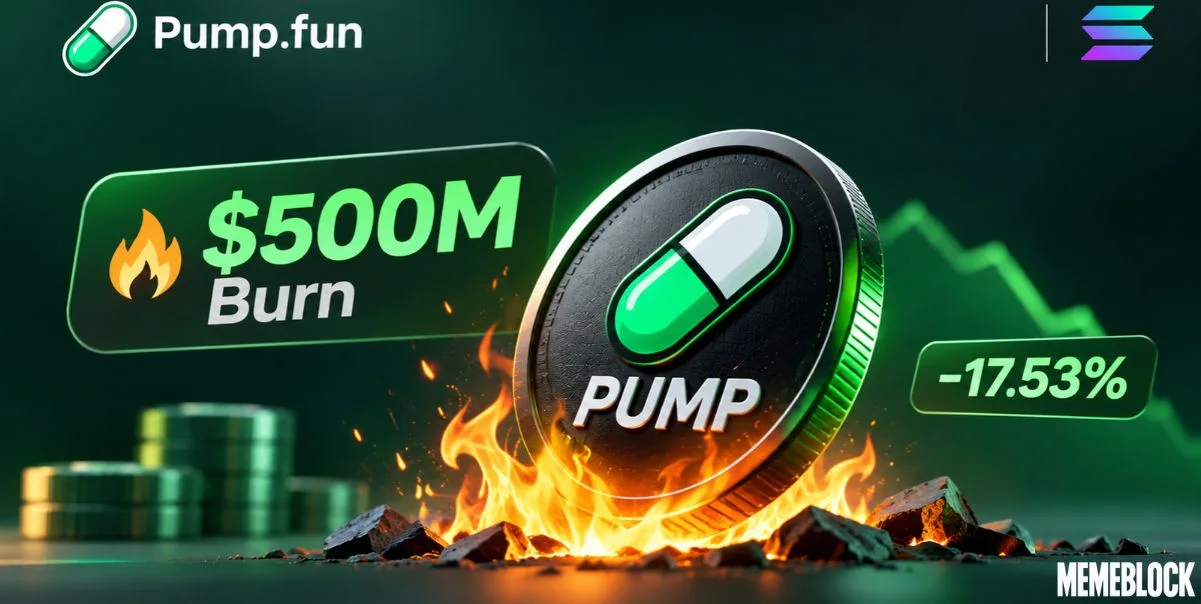
Pump.fun's cumulative PUMP buyback-and-burn programme has reached approximately $500.6 million, according to independent blockchain analytics provider Strata Terminal's data updated November 4, 2026. Separately, Pump.fun's official token dashboard reports that approximately 175.29 billion PUMP tokens have been removed from the original one-trillion-token supply, representing 17.529%.
The milestone concerns PUMP, the native token of Pump.fun, a token-launch and trading platform built on Solana. It reflects buying activity accumulated over more than a year and a subsequent change in how the platform handles purchased tokens. It is not a $500 million purchase or burn carried out in a single day.
The distinction matters because the programme has operated in two different phases. Pump.fun initially used platform revenue to purchase PUMP and accumulated the acquired tokens before burning them in April 2026. It then announced a programme directing approximately 50% of eligible net platform revenue towards ongoing PUMP purchases and burns for one year.
The latest milestone highlights the scale of that strategy, but it does not establish that PUMP's market price must rise. Token removal changes supply, while the market price continues to depend on demand, liquidity, investor behaviour, future token unlocks and the platform's ability to generate revenue.
Pump.fun's PUMP Buyback Programme Reaches Approximately $500 Million
Strata Terminal's PUMP buyback tracker reported approximately $500.6 million in cumulative buyback activity as of November 4, 2026. The same tracker measured approximately 175.28 billion PUMP removed and described that quantity as 53% of its measured circulating float.
Pump.fun's official token dashboard separately displayed 175.29 billion PUMP removed, equivalent to 17.529% of the token's one-trillion total supply. The official dashboard's token-removal figure is the primary source for the reported percentage of total supply.
The figures are close, but they should not be presented as identical measurements. Pump.fun reports the token quantity and its share of total supply. Strata Terminal provides an independent estimate of cumulative dollar value and a separate circulating-float comparison.
The 17.529% calculation is straightforward: 175.29 billion divided by one trillion, multiplied by 100. The result is 17.529%. It describes the reported quantity removed relative to the original total supply, not the percentage of all tokens that were previously circulating and available for trading.
The dollar milestone requires a separate qualification. The approximately $500.6 million figure is Strata Terminal's reported cumulative valuation. It is not an official audited financial statement from Pump.fun, and it should not be described as $500.6 million of current market value, profit or cash returned to token holders.
How Pump.fun's Revenue-Funded Buyback Mechanism Works
Pump.fun's buyback mechanism connects revenue from its platform products with purchases of PUMP in the market. The platform's April 28, 2026 announcement describes a programme allocating approximately 50% of eligible net revenue from its Bonding Curve, PumpSwap and Terminal products towards PUMP purchases and burns.
The process begins when users generate fees through activity on Pump.fun's products. These include token launches and bonding-curve trading, swaps through PumpSwap and activity associated with Terminal. Under the announced arrangement, approximately half of eligible net revenue is allocated to the buyback process.
The designated funds are used to purchase PUMP. Those purchases create buying activity in the market when transactions are executed. The acquired tokens are then burned, removing them from the token supply through the burn mechanism.
A buyback and a burn are related, but they are not the same event. A buyback is a purchase of tokens, usually in the open market. A burn is the subsequent removal of those tokens from supply. A project could buy tokens and hold them in a treasury without burning them. Pump.fun's current stated mechanism combines purchases with token removal.
This distinction is important when evaluating cumulative figures. The dollar value of historical purchases and the number of tokens burned measure different things. The dollar amount depends on the prices at which purchases occurred and the accounting method used to value them. The token quantity measures how many units have been removed.
Pump.fun's announcement also makes clear that the 50% revenue figure is an estimate for informational purposes. Its legal disclosure says that the announcement does not create an unconditional obligation to purchase PUMP, except to the extent purchases are executed automatically by smart-contract code deployed on-chain before April 28, 2026.
Why Pump.fun Changed Its Buyback Strategy
The current 50% allocation followed an earlier period in which Pump.fun directed approximately all of its revenue towards PUMP purchases.
According to Strata Terminal's historical analysis, the earlier phase ran from July 15, 2025, to April 28, 2026. During that period, Pump.fun accumulated purchased PUMP rather than immediately burning each acquired token.
On April 28, 2026, the platform announced that it had burned the accumulated position. Strata Terminal estimates that the burn involved approximately 128.06 billion PUMP, valued at around $371 million at purchase cost. The Block independently reported the event as a burn worth approximately $370 million and representing around 36% of circulating supply at the time.
That $370 million figure does not describe a single-day purchase. The tokens had been accumulated through purchases over the preceding months and were subsequently burned in the April event. Treating the entire amount as a one-day buyback would misrepresent the timeline.
Pump.fun then announced the new approach: approximately 50% of eligible net revenue would fund ongoing purchases and burns for one year, while the remaining revenue would be available for business development and expansion.
In an April 28 statement, co-founder Alon Cohen said retaining part of the revenue would give the business resources for product development, infrastructure, hiring and longer-term investment. The rationale was that directing all revenue towards token purchases could restrict the platform's ability to develop its products and ecosystem.
The policy therefore reflects two competing priorities. One is to create recurring demand for PUMP and reduce its supply. The other is to retain resources for the business that generates the revenue supporting the programme.
How Much PUMP Is Being Bought Back Each Day?
Daily buyback activity varies with platform revenue, eligible funds and transaction execution. The available trackers also have different reporting cutoffs and methodologies, so their latest figures should be attributed rather than combined.
TokenBuybacks' PUMP tracker listed $715,736 in recorded purchases for November 2, 2026. It reported $583,734 for November 1, $596,802 for October 31, $702,944 for October 30 and $712,595 for October 29.
The same tracker showed no recorded PUMP buyback for November 3 in the dataset retrieved on November 4. That is a statement about the tracker's records, not proof that no relevant transaction occurred. Its PUMP-specific page identified November 2 as the most recent recorded buyback.
For the 30 days to November 2, TokenBuybacks reported approximately $26.7 million in PUMP purchases. Strata Terminal reported approximately $25.3 million over the latest 30 days in its November 4 update.
The difference between those recent totals is another reason not to treat third-party trackers as interchangeable. They may use different data sources, valuation methods, transaction classifications and reporting windows.
TokenBuybacks says its PUMP series is based on DefiLlama holders-revenue data and public records. It describes its figures as estimates that may be revised. Strata Terminal says its tracker uses primary-source data and on-chain reconciliation. Its description says official daily data was available through October 21; for later dates, it measures changes in token total supply and estimates dollar values using daily market prices.
Strata Terminal reports that its supply watcher matched the official series within 0.04% over a 56-day comparison period, with a maximum daily difference of approximately 2.4%. It also says the daily USD estimates use Bybit closing prices, which were around 2% below Pump.fun's own average price in its comparison.
These methodological details matter. A tracker may estimate the dollar value of tokens removed using a daily market price, while another records purchases through a revenue dataset. The resulting cumulative dollar totals can differ even when both are analysing the same broad programme.
What Does Removing 17.53% of PUMP Supply Mean?
Pump.fun's official dashboard reports a one-trillion PUMP total supply and approximately 175.29 billion tokens removed. On that basis, 17.529% of the original total supply has been removed according to the dashboard.
Total supply and circulating supply are different measurements. Total supply describes the token quantity under the supply accounting used by the project. Circulating supply refers to tokens considered available in the market. Locked allocations, vesting arrangements and other restrictions can cause circulating supply to be substantially lower than total supply.
Pump.fun's dashboard showed approximately 399.46 billion PUMP circulating alongside the one-trillion total supply. Strata Terminal, meanwhile, described the 175.28 billion tokens it measured as 53% of its circulating-float calculation.
The 17.529% and 53% figures should not be compared as though they use the same denominator. The first is calculated against the one-trillion total supply. The second is Strata Terminal's comparison against its measured circulating float.
Future token unlocks also matter. If previously locked tokens enter circulation, the quantity available to trade can increase even while additional tokens are being burned. The net effect on circulating supply therefore depends on both token removals and new tokens becoming available.
A large cumulative burn can change the supply structure, but it does not by itself establish how much supply will be available to trade at a later date. That requires monitoring token unlocks, transfers, vesting and the programme's subsequent burn activity.
How Pump.fun's Buyback Model Compares With Other Crypto Projects
Revenue-funded buybacks are used by several crypto projects, but their structures and execution methods differ. Some protocols use revenue to purchase tokens and retain them. Others burn purchased tokens or direct them towards staking, rewards or other uses.
TokenBuybacks' cross-protocol tracker reported 37 active programmes. In the 30 days to November 3, 2026, it recorded approximately $66.3 million in HYPE purchases by Hyperliquid, $26.7 million in PUMP purchases by Pump.fun and $8.08 million in UNI purchases by Uniswap.
Those figures compare tracker-reported purchase spending over the same broad period. They do not establish that the projects allocate the same percentage of revenue, use identical execution methods or deliver equivalent economic benefits to token holders.
TokenBuybacks' weekly report for October 26 to November 1 also placed Pump.fun second among the tracked programmes, with approximately $4.88 million in PUMP purchases. Hyperliquid recorded approximately $16.9 million in HYPE purchases during that week, while Uniswap recorded approximately $2.88 million in UNI purchases.
Pump.fun's distinguishing feature in this comparison is its stated combination of market purchases and burns funded by a defined share of eligible platform revenue. The programme's success, however, depends on the revenue generated by the platform, the execution of purchases and burns, and the future supply and demand for PUMP.
A higher buyback total does not automatically make one token more attractive than another. It also does not demonstrate that a token is undervalued or that the market will reward the programme with a higher price.
Does Burning PUMP Guarantee a Higher Token Price?
No. A reduction in token supply does not guarantee price appreciation.
A market price is determined by the interaction of supply and demand. Buybacks can create buying pressure while purchases are taking place. Burns can reduce the number of tokens available under the relevant supply measurement. But neither action guarantees that demand will remain strong enough to lift the market price.
Selling pressure can offset buying activity. Investors may sell existing holdings, trading liquidity may change, and broader cryptocurrency market conditions may affect demand. Future token unlocks can also increase the number of tokens available to trade.
There is another important distinction between a token's supply mechanics and the rights attached to that token. Pump.fun's official April announcement states that PUMP does not represent equity, debt, a right to platform revenue, profits, dividends, distributions or other cash flows. It also warns purchasers not to expect profit, price appreciation or economic returns based on buyback activity.
Consequently, the buyback programme should not be described as a dividend or a guaranteed financial return for holders. It is a token-purchase and supply-removal mechanism. Whether that mechanism benefits the market price depends on conditions that the burn figures alone cannot establish.
Risks and Sustainability of the Revenue-Funded Programme
The programme's sustainability depends first on Pump.fun continuing to generate eligible revenue. If activity across token launches, bonding-curve trading, PumpSwap and Terminal declines, the funds available for purchases may also decline.
The second consideration is the programme's stated duration. Pump.fun announced the 50% revenue-funded programme for one year beginning in April 2026. Strata Terminal identifies the current phase as running from April 29, 2026, to approximately April 28, 2027. The current arrangement should not be assumed to continue indefinitely without a further announcement or change.
The third issue is the difference between a stated allocation and an unconditional purchase obligation. Pump.fun's legal disclosure says the approximately 50% revenue references are estimates and do not create an unconditional obligation to purchase PUMP, except for purchases executed automatically through previously deployed smart-contract code.
Strata Terminal adds a technical qualification. It says the burns are signed by ordinary hot wallets and that the phrase "programmatically locked" should not be understood as an immutable guarantee that the programme cannot be interrupted or changed. This is the tracker provider's interpretation of the observed execution setup, not a statement that the programme has been interrupted.
The final consideration is the relationship between burns and token unlocks. Continued burns may reduce total supply, but new tokens entering circulation can affect the amount available to market participants. The impact on circulating supply cannot be determined from burn totals alone.
The $500 million milestone therefore demonstrates the scale of historical activity, not a guaranteed future purchase schedule. Revenue, programme execution, token unlocks and market demand will determine how the supply picture develops.
What the $500 Million Milestone Means for PUMP Tokenomics
Pump.fun's reported milestone is significant because it combines a large historical purchase programme with a substantial quantity of tokens removed from supply. The official dashboard reports approximately 175.29 billion PUMP removed, or 17.529% of the original one-trillion supply. Strata Terminal independently estimates cumulative buyback activity at approximately $500.6 million as of November 4, 2026.
The programme's structure has changed. Its earlier phase accumulated purchased tokens before a major burn in April 2026. The current phase directs approximately 50% of eligible net platform revenue towards ongoing purchases and burns for a stated one-year period.
For PUMP holders, the central question is whether Pump.fun can sustain platform activity and revenue while continuing to execute purchases and burns. The answer will depend on future revenue, the programme's duration, the timing of token unlocks and market demand.
The milestone confirms substantial historical buyback and burn activity. It does not establish that PUMP is undervalued, that its price must rise, or that the current programme will continue at the same pace indefinitely.
Evidence Limitations
The $500 million milestone combines several different measurements: Pump.fun's official token-removal figures, Strata Terminal's independent cumulative valuation, TokenBuybacks' recorded purchase estimates and daily activity records. These figures have different sources, reporting cutoffs and methodologies. They must not be treated as one audited accounting series.
Confirmed Facts
Pump.fun is the token-launch and trading platform discussed in this report. PUMP is its native token, and Solana is the blockchain on which the token's supply and burn activity are recorded.
Pump.fun's official token dashboard reports a one-trillion PUMP total supply, approximately 175.29 billion tokens removed and a supply-reduction figure of 17.529%.
Pump.fun's April 28, 2026 announcement describes a programme allocating approximately 50% of eligible net revenue from its Bonding Curve, PumpSwap and Terminal products towards PUMP purchases and burns for one year.
Strata Terminal's November 4, 2026 tracker reports approximately $500.6 million in cumulative activity and approximately 175.28 billion PUMP removed.
Source Attribution and Measurement Differences
The approximately $500.6 million cumulative figure is reported by Strata Terminal. It is not presented on the official Pump.fun dashboard as an independently audited financial total.
Pump.fun's official dashboard reports approximately 175.29 billion tokens removed. Strata Terminal reports approximately 175.28 billion. The small difference may reflect update timing, rounding or reconciliation methodology.
TokenBuybacks reports approximately $463 million in cumulative recorded PUMP purchases since July 2025. Its tracker uses DefiLlama holders-revenue data and describes its figures as estimates derived from public data.
Strata Terminal reports approximately $25.3 million over the latest 30 days, while TokenBuybacks reports approximately $26.7 million for the 30 days to November 2. These figures should not be added together or treated as interchangeable.
The official 17.529% figure uses the one-trillion total supply as its denominator. Strata Terminal's 53% figure uses its measured circulating float. They describe different supply comparisons.
Unverified Claims and Estimates
The exact dollar value assigned to historical purchases and burns depends on the valuation method. Historical execution prices, daily market prices and the classification of transactions can produce different cumulative totals.
Strata Terminal says it uses on-chain supply changes for later daily token-removal measurements where automated access to Pump.fun's official daily series was unavailable. It estimates the corresponding USD values using daily market prices.
TokenBuybacks says its data is based on public information and may be revised. Its reported absence of a November 3 PUMP purchase is an absence of a recorded entry, not independent proof that no relevant transaction occurred.
The approximately $500.6 million figure is therefore attributed to Strata Terminal's tracker. It is not an audited financial statement issued by Pump.fun or an independent audit commissioned by MemeBlock.
Unknown Information
The reviewed sources do not establish a single independently audited cumulative dollar value for every historical PUMP purchase and burn.
They do not establish whether every future buyback will occur at the same daily rate, whether Pump.fun will extend the programme beyond its announced one-year period, or whether the 50% revenue allocation will remain unchanged after that period.
The sources also do not establish how much future revenue Pump.fun will generate, how future token unlocks will affect circulating supply, or what the future market demand for PUMP will be.
On-Chain Observations and Identity or Intent
The reported reduction in PUMP total supply is a token-level supply observation. It does not, by itself, establish the identity of every person controlling a wallet involved in the programme, the intentions of individual wallet operators or coordination beyond what the available transaction records demonstrate.
Strata Terminal describes its reconciliation of token supply and burn activity. Its observations should not be extended into unsupported claims about the personal identity or intent of wallet operators.
Conclusions the Available Evidence Cannot Support
The approximately $500.6 million cumulative figure cannot be interpreted as $500.6 million of profit for PUMP holders, cash distributed to token holders or the current market value of all burned tokens.
The reported 17.529% reduction in total supply does not prove that PUMP's price must rise. Buybacks and burns can affect supply and demand, but market prices also depend on liquidity, selling pressure, investor demand, token unlocks and wider cryptocurrency market conditions.
The programme does not establish that PUMP holders own part of Pump.fun or have a contractual right to its platform revenue. Pump.fun's official disclosure explicitly states that PUMP does not represent equity, dividends, distributions or a right to revenue.
The available data also cannot establish that the programme will continue indefinitely, maintain the same pace or guarantee a particular market outcome.
Editorial Conclusion
Pump.fun's official dashboard reports approximately 175.29 billion PUMP removed, equivalent to 17.529% of its original one-trillion-token supply. Strata Terminal independently estimates cumulative buyback activity at approximately $500.6 million as of November 4, 2026, while TokenBuybacks reports a different cumulative purchase total under its own tracking methodology. The evidence supports a substantial historical supply reduction, but it does not establish guaranteed future purchases, token-price appreciation or indefinite programme sustainability.