
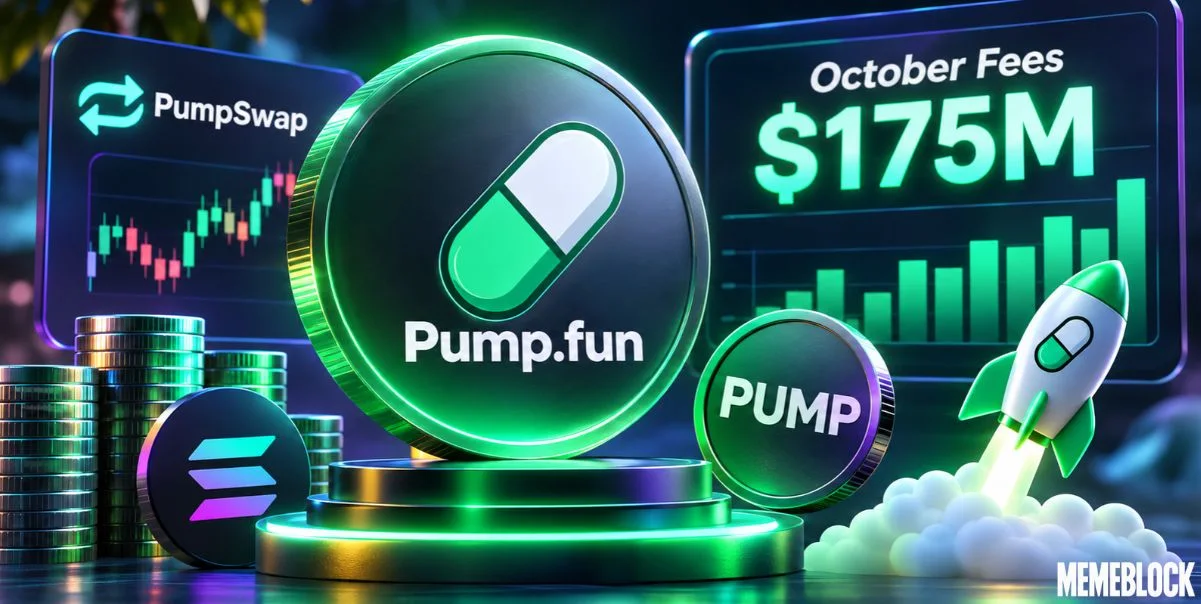
Pump.fun's October 2026 financial performance reveals a significant change in how its business generates activity. The Solana-based platform began as a destination for launching meme coins, but its expanding product ecosystem now includes a decentralized exchange, a trading terminal and a mobile application. These services create different sources of transaction activity, making the platform's financial performance more complex than the number of tokens launched or the volume generated by its original bonding-curve system.
According to PumpFYI's analysis of DefiLlama data, October was the strongest month in the dataset for total fees across Pump.fun's products. However, the more interesting finding is the distribution of that activity. PumpSwap, which handles trading in graduated tokens, contributed the largest product-level fee amount. This suggests that the platform's economic activity is increasingly connected to what happens after a token completes its initial launch process. The development also raises a useful question: is Pump.fun becoming more than a token launchpad?
The Financial Record Behind Pump.fun's October Performance
The October dataset requires three separate financial measurements to be understood correctly: total fees, protocol revenue and holders revenue. PumpFYI's historical fee and revenue dataset, based on DefiLlama's public data, records approximately $175 million in total fees, $62.4 million in protocol revenue and $29 million in holders revenue associated with PUMP buybacks for the month.
These categories describe different movements of money. Fees represent what users paid across the tracked products, including amounts allocated to creators and liquidity providers. Protocol revenue represents the amount attributed to the platform under the data provider's methodology, while holders revenue records purchases of PUMP through the platform's buyback wallets. Consequently, the gross fee total should not be presented as the company's net earnings or profit. DefiLlama publishes its own measurement definitions on its Pump protocol dashboard, allowing readers to examine how the reported categories are calculated.
PumpSwap's Contribution Changes the Platform's Business Profile
The product-level breakdown is particularly revealing because PumpSwap generated approximately $107 million in October fees, compared with approximately $61.9 million from the original bonding-curve and website platform-fee activity. Terminal contributed around $4.44 million, while the mobile application accounted for approximately $1.63 million. These figures come from PumpFYI's October product breakdown, which uses DefiLlama data.
PumpSwap serves a different purpose from the original launch mechanism. The bonding curve supports the early trading process for newly created tokens, whereas PumpSwap provides a market for assets that have progressed beyond that stage. Its contribution indicates that trading in graduated tokens has become a major part of the platform's financial activity. This matters because a token can continue generating exchange activity after its initial launch period, giving the ecosystem another source of transactions beyond the arrival of new projects.
Why the Exchange Model Matters More Than Launch Counts Alone
A launchpad's token count measures how many assets creators introduce, but it does not reveal how much trading takes place after those assets enter the market. Pump.fun's product structure connects these two stages. A creator can introduce a token through the bonding-curve system, while traders can continue interacting with eligible assets through PumpSwap after graduation. This creates a relationship between initial token distribution and subsequent exchange activity.
The exchange also has its own fee structure. According to DefiLlama's methodology for PumpSwap, trading fees include liquidity-provider, protocol and creator components. The protocol's retained share is therefore not identical to the total amount charged on every trade. This distinction helps explain why product-level fees and protocol revenue should be evaluated separately. It also means that an increase in exchange activity does not automatically translate into an equal increase in the amount retained by the platform.
PUMP Buybacks Connect Platform Activity With Its Token
Pump.fun's native PUMP token is linked to the platform's financial activity through a buyback mechanism. The mechanism uses funds generated by the wider product ecosystem to purchase PUMP in the market. DefiLlama classifies these purchases under holders revenue, as explained in its public methodology and the historical figures presented by PumpFYI.
There is, however, a data-reconciliation issue that deserves attention. PumpFYI's buyback tracker compares DefiLlama's historical calculations with figures displayed on Pump.fun's own PUMP page. It reports that the two sources showed different cumulative totals for the same historical date. Pump.fun's own page also carried a warning that its fee dashboard did not accurately reflect revenue and buyback amounts following the introduction of custom trading pairs. This means researchers should identify the source and observation date rather than combining the totals or presenting either dashboard as an independent audit of every token purchase and burn.
The Official Fee Structure Adds Another Layer
Pump.fun's own documentation provides further context for understanding how platform charges work. Its official fee documentation explains that trades made through its website and mobile application can carry a platform fee in addition to other applicable trading charges. The published schedule states that a 0.45% platform fee began on October 17, 2026, for qualifying trades through those interfaces.
This change is relevant when comparing monthly figures because the new charge applied for only part of October. It also demonstrates why a product's total fees can reflect several different components rather than one uniform rate. Traders may encounter protocol, creator, liquidity-provider, platform or third-party charges depending on the asset, trading venue and interface used. A comparison of monthly revenue without accounting for changes in fee schedules can therefore miss an important part of the explanation behind the numbers.
What November's Data Says About the October Record
A record month does not establish that the same level of activity will continue indefinitely. PumpFYI's snapshot dated November 11 recorded approximately $138 million in fees over the 30 days ending November 10, compared with approximately $183 million during the preceding 30-day window. The latest period also showed approximately $50 million in protocol revenue. These are rolling-period measurements rather than completed calendar-month results, so they should not be directly substituted for October's final figures.
The comparison provides a more cautious view of the platform's momentum. Pump.fun remained a substantial source of trading-related activity, but the pace in the latest rolling window was lower than in the preceding one. Future assessments will need to examine whether this movement reflects temporary changes in cryptocurrency market conditions, reduced participation in meme coin trading or a longer-lasting shift in activity across the platform's products. The available fee data alone cannot establish which explanation is responsible.
What the Development Means for the Solana Memecoin Ecosystem
Pump.fun's expansion illustrates how a successful token launchpad can develop into a broader trading ecosystem. Token creation attracts projects and early participants, while an associated exchange can provide a place for continued trading. The relationship creates opportunities for activity at different stages of a token's life cycle, but it also makes the platform dependent on sustained participation from both creators and traders.
The financial data does not establish that individual meme coins are successful investments, that their communities will remain active or that traders are collectively profitable. It measures activity attributed to the platform and its products. For investors and researchers, the more useful question is whether trading activity remains diverse and sustainable rather than being concentrated in a small group of highly active assets. That requires separate research into liquidity, token distribution, trading concentration and project outcomes.
Conclusion
Pump.fun's October performance highlights the growing importance of its wider product ecosystem, particularly the exchange activity supported by PumpSwap. The platform's financial structure now involves several distinct sources of fees, different allocations and a token buyback mechanism, making a single headline figure insufficient to describe its business.
The next important development will be whether the exchange and launchpad continue attracting sustained participation after the October record. Product-level activity, transparent financial reporting and consistent measurement methods will provide a stronger basis for evaluating that progress than launch counts or gross fee collections alone.
Frequently Asked Questions
1. What is the difference between Pump.fun and PumpSwap?
Pump.fun provides the token-launching and bonding-curve environment, while PumpSwap is the decentralized exchange used for trading tokens that have progressed beyond the initial launch stage.
2. Does a high fee collection mean Pump.fun is profitable?
No. Fee collection and protocol revenue are different measurements, and neither alone establishes net profit after operating expenses.
3. How does Pump.fun's buyback mechanism work?
The platform uses funds from its wider product activity to purchase its PUMP token in the market. The reported purchases are tracked separately from ordinary trading fees.
4. Where can Pump.fun's fee structure be checked?
Its official fee documentation describes applicable charges for different trading environments and interfaces. DefiLlama separately publishes its methodology for tracking platform fees and revenue.
5. Does PumpSwap activity prove that graduated meme coins are successful?
No. Exchange activity shows that transactions are taking place, but it does not establish long-term demand, profitability or sustainable liquidity for individual tokens.