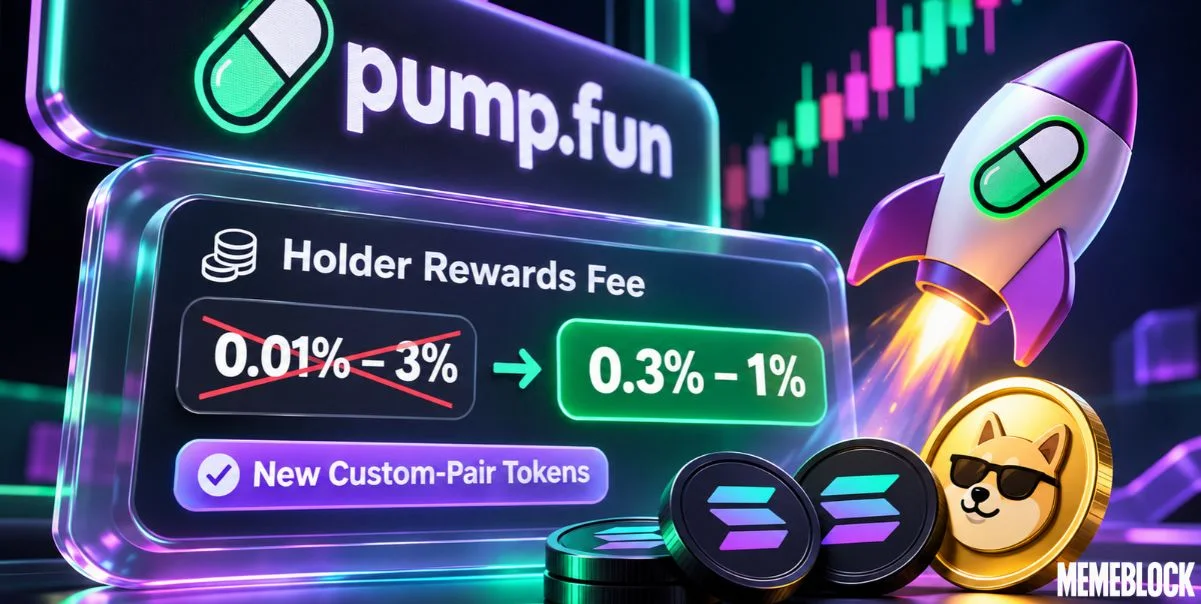
Pump.fun has revised the Holder Rewards fee settings available to new custom-pair token launches, introducing a narrower range on November 13, 2026. The adjustment changes the percentages creators can allocate to eligible holders and follows concerns raised by co-founder Alon about competition between projects using reward rates to attract attention.
The change affects a specific part of Pump.fun's launch system. It does not introduce a new token, alter the underlying Solana network, or establish a new reward program. Instead, it changes the fee options available to qualifying custom-pair launches.
A Narrower Range for New Launches
Before the revision, eligible custom-pair tokens could select Holder Rewards rates between 0.01% and 3%. The new range is 0.3% to 1%, according to Pump.fun's November 13 announcement.
Holder Rewards allows creators to allocate an eligible portion of trading fees to qualifying token holders. The distribution is connected to trading activity and eligible wallet balances, rather than being a fixed payment promised to every holder.
The revised range changes the choices available during a qualifying launch. It does not assign every token the same rate. Creators can still select a percentage within the permitted range.
Pump.fun announced the adjustment through its official account.
Why Pump.fun Changed the Settings
Pump.fun co-founder Alon said the previous fee structure encouraged competition between creators.
He described a situation in which one creator launched a token with a relatively small reward percentage, while another creator could launch a competing project with a higher rate to attract potential holders.
This created an incentive to compete through reward allocations rather than through differences in a project's concept or community. Alon characterized the behavior as unnecessary player-versus-player competition, commonly referred to as PVP in crypto communities.
The revised range is intended to reduce the incentive to use unusually high or low reward percentages as a competitive tool. However, the announcement does not include historical launch data measuring how frequently creators used this approach.
Alon's public explanation is the source for the platform's stated reasoning.
How the Rules Differ Across Tokens
The adjustment applies to new eligible custom-pair launches. Previously launched tokens retain their existing reward settings, according to Alon.
SOL- and USDC-paired tokens are also outside the scope of this particular revision. They follow separate tiered creator-fee arrangements, so their fee options should not be evaluated using the new custom-pair range.
This distinction is relevant when comparing tokens launched at different times. A project using an older configuration may display a reward percentage that is no longer available to a newly launched eligible custom-pair token.
The Difference Between Rewards and Trading Costs
Holder Rewards is one component of Pump.fun's fee structure. Traders may also encounter protocol fees, liquidity-provider fees and platform charges, depending on the transaction route.
Pump.fun's archived October 31, 2026 fee documentation lists a 0.95% protocol fee for bonding-curve transactions. For canonical PumpSwap pools, it lists a 0.05% protocol fee and a 0.20% liquidity-provider fee.
Using those figures alongside the revised reward range and the documented 0.45% platform fee, an illustrative single-pool transaction produces the following estimates:
Trading route | Estimated combined fees |
|---|---|
Bonding curve | 1.70%–2.40% |
Canonical PumpSwap pool | 1.00%–1.70% |
These estimates assume a transaction without a referral discount. They combine the applicable documented charges rather than representing a live quote for an individual trade.
The archived fee schedule can be reviewed through Pump.fun's October 31 documentation.
What the Revision Means for Creators
For creators, the adjustment changes one part of the token-launch configuration. They have fewer reward-rate options when setting up a new eligible custom-pair token.
That may reduce the usefulness of reward percentages as a way to differentiate competing launches. However, creators can still distinguish projects through their token distribution, community development, branding and other launch decisions.
The policy does not remove competition between memecoin projects. It changes the range of one specific incentive that creators can configure.
What Holders Should Understand
A reward percentage does not independently determine the amount a holder receives. Actual distributions depend on the fees generated by trading activity and the holder's qualifying balance.
Pump.fun's archived documentation describes eligibility requirements, including a minimum holding equivalent to $20, as well as conditions governing distributions. These requirements are separate from the percentage selected by a creator.
For holders, the relevant distinction is between the advertised reward rate and the amount actually distributed. A token's selected percentage alone cannot establish its future reward income or market performance.
What Remains to Be Seen
The effect of the adjustment will become clearer through activity involving new eligible launches. Useful measurements would include the reward rates creators select, the number of custom-pair launches and the distribution of rewards among qualifying wallets.
Pump.fun has not published a before-and-after dataset showing whether the revised settings have reduced reward-based competition. It is therefore too early to conclude that the change has improved holder retention or launch performance.
Evidence Limitations
The revised range and the treatment of existing tokens are supported by Pump.fun's November 13 announcement and Alon's public explanation. The transaction-cost examples use an archived October 31 fee schedule, not a live transaction quote.
The platform has not released quantitative evidence establishing the previous frequency of reward-based competition or measuring the results of the new policy. The available records also do not establish whether the revision will change trading volume, token survival or holder retention.