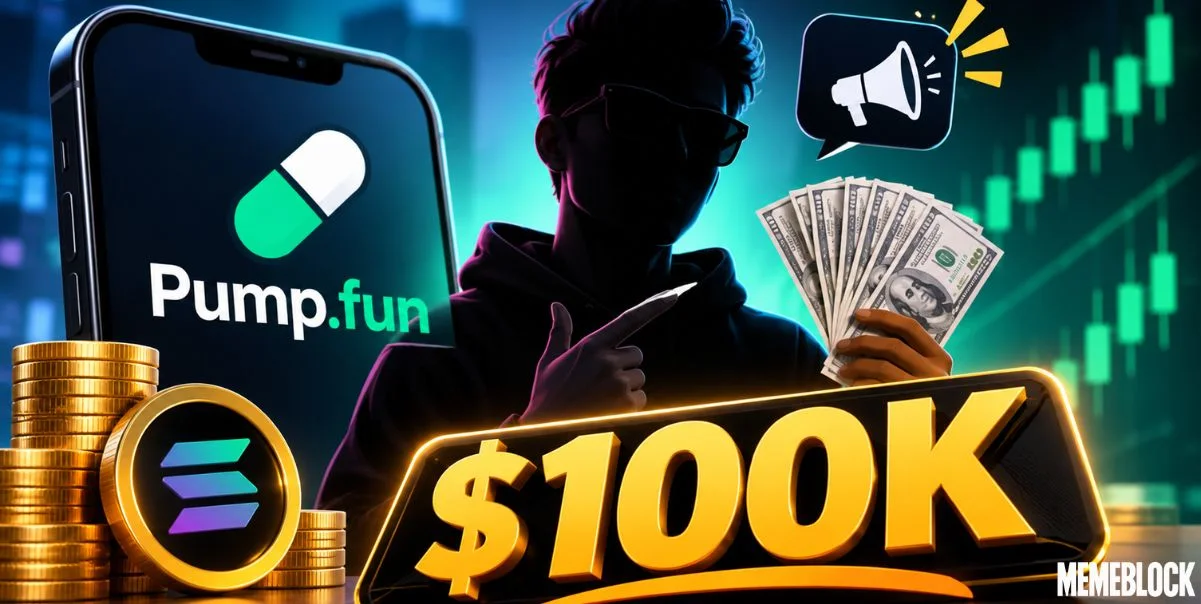
On November 19, 2026, screenshots surfaced on X alleging that Solana-based memecoin launchpad Pump.fun (PUMP) offered an unnamed crypto influencer $100,000 per month to leave rival social trading app Fomo and promote tokens daily. The unverified claims have renewed scrutiny over how Pump.fun incentivizes trading volume through paid token recommendations, raising trust concerns for retail traders who follow influencer callouts.
What the leaked screenshots allege about the Pump.fun offer
According to screenshots posted on X by crypto user TheSolstice on November 19, 2026, an anonymous large-account trader claimed Pump.fun approached them in August 2026 with a $100,000 monthly base offer to quit Fomo and switch to Pump.fun. According to The Crypto Times, the trader stated that custom referral fees and promotional callout rewards could have pushed total monthly earnings to between $200,000 and $300,000.
The unnamed trader claimed Pump.fun required them to actively buy and sell different coins daily referred to in the messages as "aping in and out of coins" rather than holding and discussing a single token. The trader stated they rejected the proposal because they were unwilling to guarantee frequent token callouts.
As of November 21, 2026, no public contract, payment record, or independent verification has been produced to confirm the $100,000-per-month offer. The Crypto Times noted it reached out to Pump.fun for comment, and the allegations remain unverified.
How Pump.fun’s Callout Rewards program works and why it faces scrutiny
The allegations come as Pump.fun expands its public Callout Rewards program, which launched in August 2026 and pays users in USDC for posting token recommendations that drive engagement and trading activity. On November 17, 2026, Pump.fun co-founder Alon Cohen reported that cumulative payouts had reached $33 million across nearly 55,000 callers. That same day, Pump.fun announced an additional campaign offering up to $20,000 per day in combined incentives $10,000 via Merkl matched by Pump.fun for token callouts on Coinbase's Base network.
Despite the program's growth, independent analyses have raised concerns about follower outcomes and payout concentration:
Concentrated payouts: According to crypto.news, ten wallets collected roughly 16% of total distributed rewards, while the median recipient earned $13.
Follower losses: Independent analysis by Sparsity Research found that followers of 10 tracked small-cap token callers were collectively down approximately $926,000 one day after recommendations. Across those tracked calls, the median token gained 6% in the first minute before dropping 48% after one hour and 74% after 24 hours.
Prior analytics scrutiny: In October 2026, blockchain analytics firm Bubblemaps accused influencer Ethan of generating an estimated $125,000 from trading and promotional rewards tied to 49 token callouts, alleging associated wallets bought before public posts and began selling an average of three minutes later. Bubblemaps noted that common ownership of those wallets was not independently established.
Pump.fun has adjusted its program rules to address criticism. Starting October 10, 2026, Alon Cohen announced that Callout Rewards would factor in followers' trading profitability and reduce incentives for promoting low-cap tokens. However, Pump.fun does not publish its exact reward calculation formula.
What does this mean for Pump.fun traders and PUMP holders?
For retail traders on Solana, the controversy highlights the risk of acting on high-frequency influencer token callouts, where thin liquidity and rapid exits often leave late buyers at a loss. For PUMP token holders, the reputational scrutiny adds pressure alongside recent market weakness; as of November 20, 2026, CoinMarketCap data showed PUMP trading at $0.00256, down 23.73% over the prior seven days, even as the platform expands into new verticals like its November 16 Polymarket prediction markets integration.
While Pump.fun’s terms require participants to disclose paid promotions and prohibit coordinated price manipulation, the absence of a public reward formula combined with unverified claims of private volume-driven deals leaves open questions about how effectively the platform can align influencer incentives with retail trader outcomes.