Launching a cryptocurrency has become easier than building one that people continue trading. Pump.fun has turned token creation into a relatively accessible process on Solana, allowing users to introduce new meme coins without developing a conventional blockchain project. The result is an ecosystem where thousands of assets can appear within a short period, competing for attention from the same pool of traders.
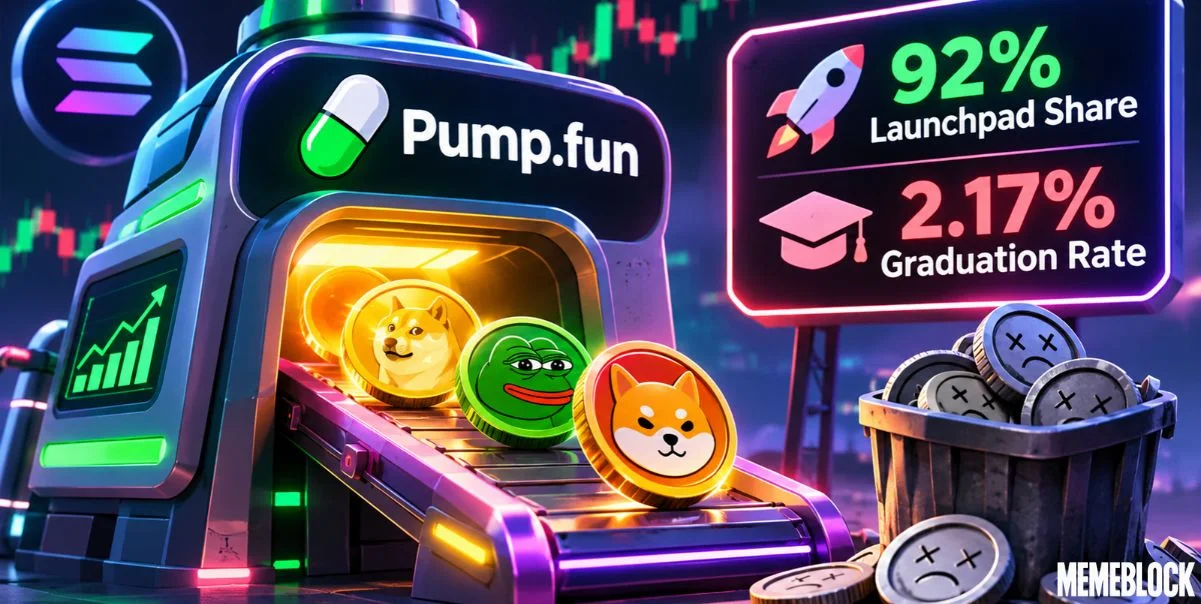
Recent launchpad data highlights the scale of this activity. According to TokenPost's November 11, 2026 report, Pump.fun accounted for 92% of memecoin launchpad launches across all chains during the 30 days ending November 9. Its share of trading volume reached 84% during the same period.
However, platform popularity and individual token performance are two different measures. A launchpad can attract creators and generate substantial transactions without most of its newly created assets developing an active market. Data from PumpData provides a closer look at that difference.
Pump.fun's Position in the Launchpad Market
TokenPost's November 11 analysis identified Pump.fun as the leading platform in the memecoin launchpad market. Its reported market shares indicate that creators and traders were heavily concentrated within the platform during the measured 30-day period.
The report also examined where Pump.fun generated its protocol revenue. Tokens still on bonding curves or carrying market capitalizations below $250,000 accounted for 95% of reported revenue.
This finding places early-stage token activity at the center of the platform's business model. It also distinguishes the launchpad's commercial performance from the performance of individual tokens. Protocol revenue reflects activity on the platform; it does not demonstrate that the underlying projects have become successful.
Why Newly Launched Tokens Matter to Pump.fun's Revenue
The age of a token was another important factor in TokenPost's analysis. According to the report, tokens less than one hour old generated approximately 75% of Pump.fun's protocol revenue. Assets less than 24 hours old accounted for 87%.
Pump.fun's reported fee structure helps explain the importance of this early trading activity. TokenPost stated that the platform charges a 1.25% fee on each bonding-curve buy or sell. The report attributed 0.95% to the platform and 0.30% to the token creator.
These fees are associated with transactions rather than a token's long-term survival. Consequently, early trading can generate revenue even when a project does not maintain an active community or progress into a more established market.
PumpData's Daily Graduation Figures
A separate dataset from PumpData examined activity on November 11. Its daily tracker recorded 42,369 token launches and 920 graduations, producing a reported graduation rate of approximately 2.17%.
PumpData also recorded 4,223,646 SOL in trading activity, valued at approximately $354.5 million in its report. The tracker listed 610,610 wallets and more than 14.4 million trades.
The graduation rate measures how many recorded launches completed the platform's bonding-curve process during the reported period. It should not be interpreted as the percentage of tokens that became profitable investments or developed sustainable markets.
PumpData further reported that 92% of the day's newly launched tokens received no trades during their second hour. This is a separate activity measurement: it concerns subsequent trading rather than whether a token completed graduation.
The Difference Between Launching and Building a Market
A token launch creates an asset that traders can discover and potentially purchase. Building an active market requires additional participation, including buyers, sellers and sufficient liquidity to support transactions.
This distinction helps explain why launch statistics can look impressive while individual projects struggle to maintain attention. A large number of new assets compete for a limited amount of trader interest. Many receive initial attention but fail to attract continued activity.
TokenPost's cumulative figures provide another measure of this competition. The publication reported approximately 24.4 million cumulative launches by November 9, with 312 tokens identified above a $100,000 market capitalization at its measurement point.
The same report compared historical results for a higher market-capitalization threshold. In the fourth quarter of 2024, 207 out of 3.16 million launches reached a $10 million market capitalization. During the third quarter of 2026, the corresponding figure was 24 out of 3.05 million launches.
These are market-capitalization milestones, not graduation statistics. They describe different outcomes and should not be combined into one measure of token success.
PumpSwap's Competition in Daily Trading
Pump.fun's broad market position does not mean that competing platforms cannot record higher trading volume on individual days.
In a November 11 report using DefiLlama data for November 10, BlockFOMO recorded approximately $94.39 million in full-day volume for PumpSwap and $92.13 million for Pump.fun. The same report listed approximately $6.43 million for Raydium LaunchLab and $3.37 million for Meteora Dynamic Bonding Curve.
These figures represent a single-day comparison, rather than the 30-day launchpad market shares reported by TokenPost. They therefore provide a different view of platform activity.
BlockFOMO also examined a sample of recently created pools using GeckoTerminal observations. Its selected sample included 16 of 20 PumpSwap pools and 18 of 20 Pump.fun bonding-curve pools created during the preceding 24 hours. The publication described these observations as a sample of busy pools, not a complete count of every launch.
The comparison illustrates that competition remains active even within a market dominated by one major launchpad. Trading volume can shift between platforms depending on the tokens attracting attention during a particular period.
What These Trends Mean for Token Creators
For creators, the main challenge begins after a token is launched. Creating an asset does not automatically produce a community, trading demand or a reliable market.
A project needs to attract participants who are interested in holding or trading its token beyond the initial launch. Without continued participation, early activity can disappear quickly. Liquidity also matters because traders need functioning markets to enter and exit positions.
The data also raises questions about how success should be measured in the launchpad ecosystem. The number of launches indicates platform usage, while graduation measures progression through a particular launch mechanism. Trading volume measures transactions, and market capitalization reflects a valuation calculated from price and supply.
None of these measurements alone establishes that a project has a sustainable business model or that its holders have made profits.
Conclusion
Pump.fun's position shows how quickly token creation has expanded within the memecoin market. Its platform activity has attracted a large share of launchpad users, while the reported revenue figures demonstrate the commercial importance of early token trading.
The more difficult challenge lies with individual projects. Moving beyond an initial launch requires sustained participation, active markets and continued interest from traders.
For the wider memecoin ecosystem, the distinction between creating a token and developing a lasting market remains central. A successful launchpad does not necessarily produce successful tokens, and a large number of launches should not be confused with long-term adoption.