
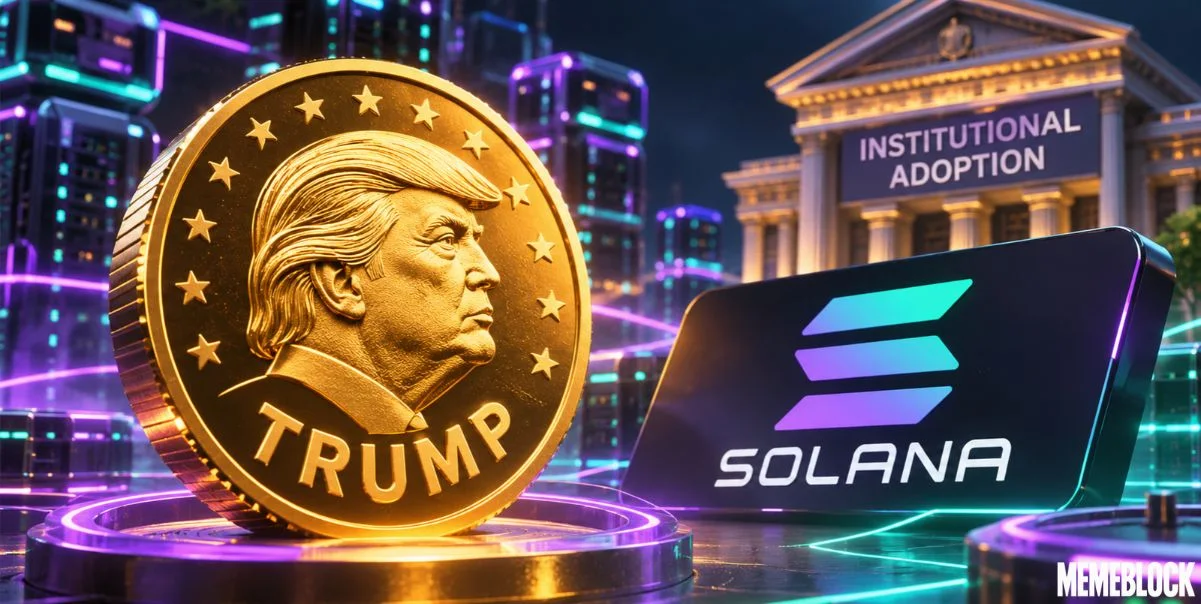
Solana Foundation President Lily Liu said the January 2025 launch of the TRUMP memecoin and the October 2025 cryptocurrency liquidation event tested the network's infrastructure under unpredictable trading pressure. Speaking to The Block's Gareth Jenkinson at Solana Breakpoint in London, Liu presented the two episodes as real-world demonstrations of Solana's ability to process activity during periods of intense market demand.
Her comments, published by The Block on November 17, 2026, come as traditional financial institutions announce plans to use Solana for tokenized securities. However, the historical performance figures cited in the interview should be distinguished from independently verified network measurements and future institutional deployment plans.
TRUMP's January 2025 launch became an infrastructure test
The TRUMP token was introduced on January 17, 2025, by entities affiliated with U.S. President Donald Trump, according to its SEC-filed registration statement. It was issued as a Solana-based SPL token rather than operating on its own blockchain.
Liu told The Block that trading began on a Friday evening and continued through a weekend when traditional financial markets were closed. She pointed to the activity handled by Solana's validators, wallets, liquidity pools and transaction routers as an example of infrastructure facing unpredictable demand.
Liu described the launch as one of the decade's biggest trading events and argued that the network's decentralized infrastructure handled the activity without the disruption she associated with centralized financial platforms.
Her argument was specifically about the infrastructure processing transactions, not an endorsement of the memecoin itself. She acknowledged that investors hold different opinions about memecoins as an asset class.
That distinction matters: a blockchain's ability to process transactions does not establish the economic value, legitimacy or long-term performance of the tokens traded on it.
The SEC filing confirms the token's issuance and launch details, but it does not independently verify Liu's assessment of Solana's network performance during the launch. The infrastructure assessment remains her attributed interpretation rather than a finding established by the registration statement.
Liu also points to the October 10 liquidation event
The second example Liu cited was the October 10, 2025 cryptocurrency market sell-off, commonly called the 10/10 liquidation event.
According to CoinGlass's 2025 annual report, combined long and short liquidations exceeded $19 billion during the October 10–11 event. CoinDesk also reported the scale of the forced closures using CoinGlass data.
The Block reported Liu's statement that Solana briefly reached approximately 60,000 transactions per second during the episode without going offline.
However, the two figures should not be treated as independently verified measurements of the same event. The market-wide liquidation total covers a broader reporting window, while the 60,000 TPS figure is attributed to Liu. The accessible reporting does not provide a historical Solana telemetry record or explain whether the TPS measurement includes vote transactions, non-vote transactions or attempted transactions.
Consequently, the episode provides context for Liu's infrastructure argument, but the exact throughput figure cannot be independently reproduced from the sources reviewed for this article.
DTCC's Solana integration remains a 2027 plan
The institutional context behind Liu's remarks is more concrete in one important respect: the Depository Trust & Clearing Corporation has officially announced plans to connect its tokenization service to Solana.
In its November 12 announcement, DTCC said that eligible assets held by its Depository Trust Company subsidiary are expected to become available on Solana in the second half of 2027.
The service is intended to support the conversion of eligible traditional assets into tokenized form and related token lifecycle functions. DTCC said tokenized assets made available through the service will retain the investor protections, ownership rights and regulatory safeguards applicable to traditionally held securities.
The timing is important. DTCC's tokenization service launched on October 28, 2026, but its planned Solana connection is a separate future integration. The November announcement does not mean that DTC-custodied securities are already available for trading on Solana.
The distinction between an announced integration and a live deployment is central to assessing how far institutional adoption has progressed.
What the two stress tests actually demonstrate
Liu's examples cover two different kinds of market pressure. The TRUMP launch involved concentrated trading activity around a newly introduced token, while the October 2025 event involved forced liquidations across the wider cryptocurrency derivatives market.
Both episodes are relevant to the question of whether blockchain infrastructure can operate during unpredictable trading conditions. But neither event, by itself, establishes that Solana will meet every requirement of regulated securities markets.
Institutional deployments also involve custody arrangements, investor protections, compliance processes, operational controls and integration with existing financial infrastructure. DTCC's announcement outlines a future connection, not a completed demonstration of every one of those requirements.
For now, the verifiable development is the institutional roadmap: DTCC has formally named Solana as a planned network for its tokenization service, with eligible assets targeted for availability in the second half of 2027. Liu's comments explain why the Foundation believes earlier periods of market stress are relevant to that institutional ambition.