
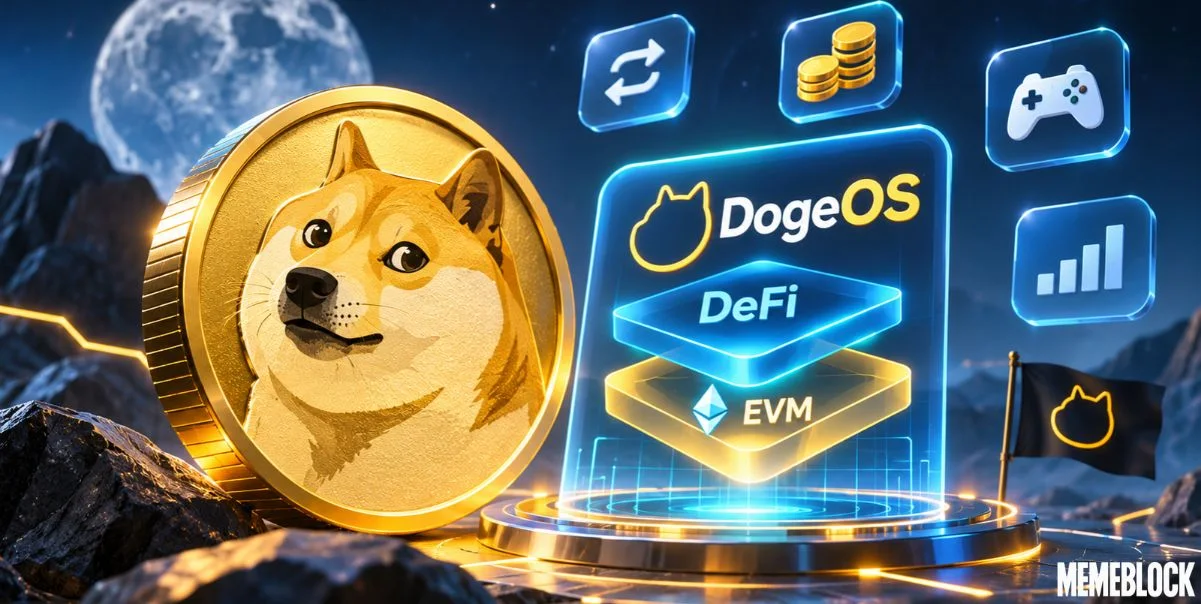
Dogecoin has spent much of its existence as a cryptocurrency associated with internet culture, tipping and payments. Its large community and recognizable identity helped it become one of the most widely followed digital assets, but its original blockchain was not designed to support the same range of decentralized applications available on Ethereum. DogeOS is attempting to address that limitation by introducing an Ethereum-compatible application layer that could allow developers to build decentralized finance products, games and other smart-contract applications connected to the Dogecoin ecosystem.
The project is moving closer to its mainnet launch. DogeOS founder and CEO Jordan Jefferson told The Block on November 11 that development of version one and its security audits had been completed. The team is now concentrating on deployment and integrations with wallets, exchanges and other protocols. However, Jefferson did not provide a confirmed launch date, meaning the announcement represents a development milestone rather than proof that the network is already operating on mainnet.
The larger question is whether Dogecoin can develop an application economy without changing the blockchain that made it popular. DogeOS offers one possible route, but its architecture also introduces security and infrastructure considerations that DOGE holders should understand before treating the project as an established DeFi network.
Why Dogecoin Needs an Application Layer
Dogecoin's original blockchain is primarily designed to transfer DOGE between addresses. It supports a relatively straightforward payment model, but it does not natively offer the general-purpose smart-contract environment used by Ethereum applications.
This limitation has shaped the way people interact with the asset. DOGE can be held, transferred, exchanged and used for payments, but developers cannot simply deploy a conventional Ethereum lending protocol or decentralized exchange directly onto Dogecoin's base layer.
DogeOS is designed to provide that missing application environment without requiring a complete redesign of the original blockchain. According to its official developer documentation, the project operates as an EVM-compatible application layer built on Dogecoin. Developers familiar with Ethereum can use familiar programming tools, dependencies and smart-contract workflows to develop applications for the network.
This compatibility is important because it reduces the need for developers to learn an entirely different development environment. Existing Ethereum-oriented teams can potentially adapt their applications and infrastructure for DogeOS, although compatibility does not automatically guarantee that every application will work without modifications or additional security testing.
What DogeOS Actually Adds to the Dogecoin Ecosystem
DogeOS is intended to support applications that go beyond ordinary cryptocurrency transfers. Its proposed use cases include decentralized trading, lending, stablecoins, prediction markets and blockchain games.
These applications could give DOGE holders additional ways to interact with their assets. For example, a lending application could allow users to supply eligible assets to a protocol, while a decentralized exchange could facilitate token swaps without relying on a conventional centralized trading platform.
The distinction is that these applications would operate through DogeOS rather than being executed directly by Dogecoin's original transaction system. The application layer provides the environment for smart contracts, while its relationship with Dogecoin is intended to connect the wider ecosystem to the underlying network.
According to The Block's September 30 report, DogeOS launched a public testnet before the latest mainnet announcement. The testnet gave developers an environment to experiment with applications before the production network becomes available.
How the EVM-Compatible Architecture Works
The Ethereum Virtual Machine, commonly called the EVM, is the execution environment used by Ethereum smart contracts. An EVM-compatible network can support smart contracts written and compiled for that environment, allowing developers to reuse familiar tools and application designs.
DogeOS uses this compatibility to make application development more accessible to Ethereum developers. Rather than asking every team to build new infrastructure from scratch, it aims to provide an environment in which existing development knowledge can be applied to Dogecoin-related applications.
The architecture is also described as a zero-knowledge rollup. In simple terms, a rollup processes transactions on a separate execution layer and produces cryptographic evidence intended to demonstrate that state changes followed the network's rules. The system then connects those state updates to an underlying blockchain.
However, the term zero-knowledge rollup should not be interpreted as meaning that Dogecoin's miners already verify every DogeOS transaction. The current implementation has additional infrastructure between application execution and the Dogecoin base layer, and that distinction is central to evaluating its security model.
The Biggest Technical Question: Who Verifies DogeOS Transactions?
DogeOS's initial security design relies on selected network operators, validators, a permissioned sequencer and a trusted execution environment. These components perform different functions in processing transactions and validating updates.
A sequencer determines the ordering of transactions submitted to the application layer. Validators participate in checking network updates, while a trusted execution environment provides a protected hardware environment intended to support the execution and verification process. A Security Council also forms part of the initial system design.
According to CoinDesk's technical analysis published on October 1, Dogecoin's base layer does not currently verify DogeOS's zero-knowledge proofs directly. The current bridge process instead relies on valid proofs together with signatures from a majority of the validator set and a trusted execution environment signer.
This creates an important difference between using an application layer connected to Dogecoin and having Dogecoin's own miners independently verify its execution. Users interacting with the initial version therefore depend on additional operators and infrastructure rather than relying exclusively on the original Dogecoin consensus mechanism.
That is not automatically evidence of a security failure. Many blockchain application layers use additional infrastructure to provide functionality that their base chains do not support. However, users should understand which components they are trusting, how those components are governed and what happens if one of them becomes unavailable or compromised.
The Proposed OP_CHECKZKP Upgrade and the Role of Dogecoin Miners
DogeOS has also been associated with a longer-term proposal intended to allow Dogecoin's base layer to verify zero-knowledge proofs directly.
The proposal, known as OP_CHECKZKP, would introduce a verification capability into Dogecoin Core. If implemented and activated, it could allow Dogecoin nodes to check cryptographic evidence submitted by an application layer rather than relying entirely on external verification arrangements.
The proposal is significant because it addresses one of the main architectural questions surrounding DogeOS: how its application execution can become more directly connected to the security of the underlying Dogecoin network.
However, the proposal should not be confused with an already activated protocol upgrade. CoinDesk reported that the relevant implementation remained a draft and still required further development. The Dogecoin base layer therefore should not be described as currently verifying DogeOS execution proofs through OP_CHECKZKP.
For DOGE holders, the distinction matters more than the technical terminology. A future upgrade could change the trust assumptions of the application layer, but its benefits depend on successful development, review, community acceptance and eventual activation.
More Than 100 Builders Are Reportedly Exploring the Ecosystem
Developer participation will be another important factor in determining whether DogeOS becomes useful beyond its technical infrastructure.
In his November 11 interview with The Block, Jefferson said more than 100 builders were working on projects for the ecosystem. He mentioned applications including games and other products that could introduce additional ways to use DOGE.
The team is also prioritizing integrations with wallets, exchanges and other protocols. These integrations are important because developers need access to users, liquidity and existing crypto infrastructure if their applications are to attract meaningful activity.
A large number of developers working on a project is an encouraging ecosystem signal, but it is not equivalent to a large number of operational applications. The more useful measures after launch will include deployed products, active users, transaction activity, liquidity and the ability of applications to retain participants beyond initial incentives.
Dogecoin Labs Is Trying to Build a More Organized Ecosystem
DogeOS is part of a wider effort to coordinate development across the Dogecoin ecosystem.
On October 21, The Block reported that Dogecoin Labs had launched with connections to MyDoge, DogeOS and Such App. The organization brings together wallet, application-platform and merchant-payment initiatives under a more coordinated structure.
The Block's Dogecoin Labs report described the organization as an effort to expand Dogecoin's utility through consumer applications, payments, commerce, DeFi and gaming. The structure also aims to support development beyond reliance on community donations.
This organizational development matters because building an application ecosystem requires more than releasing a technical network. Wallets must support applications, developers need reliable infrastructure and users need straightforward ways to access products. Merchant tools can also connect the currency's payment identity with services that people use outside cryptocurrency trading.
The different initiatives serve separate functions, but their coordination could help reduce fragmentation across the Dogecoin development community.
What Could Change for DOGE Holders?
If DogeOS launches successfully and attracts useful applications, DOGE could become more than an asset primarily held or transferred between wallets. Eligible applications could create additional opportunities for trading, lending and other forms of decentralized participation.
That possibility does not mean every DOGE holder will automatically receive new income or that the token's market value must increase. DeFi applications introduce their own risks, including smart-contract vulnerabilities, liquidity shortages, bridge-related risks and potential losses from volatile collateral.
Users may also need to interact with additional wallets, application interfaces and network infrastructure. The exact experience will depend on which products become available and how integrations are implemented.
The economic impact will depend on whether applications generate genuine demand for DOGE and whether that demand persists after the initial attention surrounding the mainnet launch. Developer announcements alone cannot establish future adoption.
What Needs to Happen Before DogeOS Can Prove Its Potential?
The completion of version-one development and security audits is an important milestone, but a production network must demonstrate more than readiness to deploy.
The first test will be the mainnet rollout itself. Developers and users will need to evaluate network stability, wallet compatibility, transaction processing and the reliability of the infrastructure responsible for validating application updates.
The next test will be application adoption. A functioning decentralized exchange, lending service or stablecoin product needs users, liquidity and security reviews before it can establish a sustainable role in the ecosystem. The number of projects announced before launch will be less important than the quality and actual use of applications after deployment.
The longer-term test will concern the relationship between DogeOS and Dogecoin's base-layer security. Progress on OP_CHECKZKP and any future governance or protocol decisions will be important to watch, but no completed upgrade or activation date should be assumed.
Conclusion
DogeOS represents a significant attempt to expand Dogecoin beyond its traditional role as a payment-focused cryptocurrency and memecoin. Its EVM-compatible application layer could make it easier for developers to build decentralized finance products, games and other smart-contract applications connected to the DOGE ecosystem.
The project's progress is real, with version-one development and audits reported as complete and a mainnet deployment being prepared. However, the current architecture still depends on additional operators and verification infrastructure, while the proposed mechanism for direct Dogecoin proof verification remains a separate development goal.
The real measure of DogeOS will not be the number of applications announced before launch. It will be whether those applications attract users, create useful economic activity and establish a security model that participants can understand and trust.
Frequently Asked Questions
1. What is DogeOS?
DogeOS is an EVM-compatible application layer built around Dogecoin. It is designed to let developers create smart-contract applications without replacing Dogecoin's original blockchain.
2. Is DogeOS the same as Dogecoin?
No. Dogecoin is the underlying cryptocurrency and blockchain, while DogeOS is a separate application layer intended to expand the functionality available to DOGE users.
3. Does DogeOS support decentralized finance?
Its planned application ecosystem includes decentralized trading, lending, stablecoins and other DeFi-related products. The availability and adoption of individual applications depend on development and deployment.
4. Has DogeOS launched its mainnet?
The November 11, 2026 announcement said version-one development and audits were complete and that mainnet deployment was very close. A confirmed public launch date was not provided.
5. Does DogeOS use Ethereum?
DogeOS is EVM-compatible, which means it supports Ethereum-style smart-contract execution and familiar developer tools. It is not simply the Ethereum blockchain.
6. Do Dogecoin miners currently verify DogeOS transactions?
No. The initial architecture relies on additional operators, validators and trusted execution infrastructure. Direct verification by Dogecoin's base layer is a longer-term development goal.
7. What is OP_CHECKZKP?
It is a proposed Dogecoin Core upgrade intended to add the ability to verify zero-knowledge proofs. It should not be treated as an already activated Dogecoin feature.
8. Can DogeOS increase DOGE's price?
There is no guarantee. Additional applications could create new utility and demand, but token prices also depend on liquidity, supply, market sentiment and broader cryptocurrency conditions.