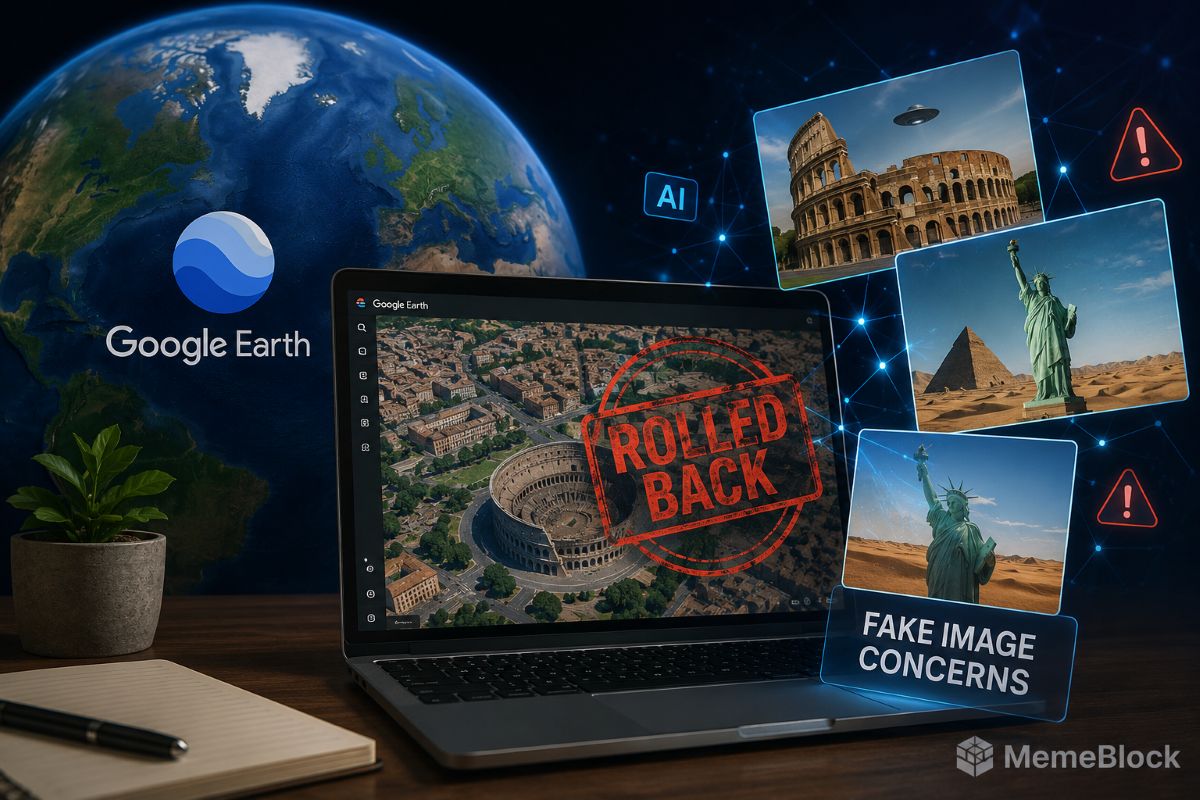
Google temporarily withdrew its new Google Earth AI image-generation feature. This decision came after researchers demonstrated how it could create convincing fake satellite imagery of real-world locations.
Google has rolled back a newly launched artificial intelligence feature in Google Earth less than 24 hours after its debut. This happened following widespread criticism that the technology could be used to fabricate realistic satellite imagery of real places.
The company confirmed the rollback after users began sharing AI-generated scenes depicting fictional disasters, refugee camps, military facilities and other fabricated events. These scenes were layered onto genuine Google Earth imagery. According to Google’s public statement, the feature is being withdrawn while additional safeguards are developed. In addition, Reuters independently confirmed the rollback and Google’s explanation.
Google said the generated images were digitally watermarked as AI-generated and never became part of the standard Google Earth experience viewed by other users. However, screenshots could still be shared across social media platforms. Therefore, concerns were raised that fabricated images might circulate without sufficient context.
AI-Generated Satellite Imagery Quickly Raised Misinformation Concerns
The feature used Google’s latest image-generation technology, identified in multiple reports as Nano Banana 2. It allowed users to modify satellite, aerial and 3D imagery through natural-language prompts.
Open-source intelligence (OSINT) researcher Henk van Ess publicly demonstrated several examples. He showed how easily fictional events could be generated using authentic geographic locations. For example, these included fabricated refugee camps near the U.S.-Mexico border. Other examples reportedly included fictional damage in conflict zones and other manipulated scenes that resembled genuine satellite photography.
Google acknowledged both the positive and negative early uses of the feature in its public statement:
“We know that people uniquely trust Google Earth for a reliable view of the world. We’ve also seen people sharing screenshots of generated imagery that appear to violate our policies. So we’re rolling back this feature in Google Earth while we work on implementing stronger guardrails.”
The company did not specify which policy violations prompted the decision or provide a timeline for restoring the feature.
Trust in Geospatial Data Presents Unique AI Challenges
Unlike conventional AI-generated artwork, Google Earth occupies a unique position. Governments, journalists, humanitarian organizations, researchers and businesses frequently rely on its imagery for location analysis and visual reference.
While Google stated that AI-generated content carried digital watermarks using its SynthID technology, researchers noted that screenshots shared on external platforms may not preserve metadata. In addition, these screenshots may not provide obvious visual indicators identifying them as synthetic.
This distinction has become increasingly important as synthetic media grows more convincing and easier to distribute across social networks.
Although the generated images never replaced Google’s official satellite imagery, experts argued that misleading screenshots alone could create confusion during natural disasters, armed conflicts or other breaking news events.
Google Joins Broader Industry Effort to Strengthen AI Safeguards
The rollback comes amid increasing scrutiny of generative AI products across the technology industry.
Technology companies have faced mounting pressure from regulators, researchers and civil society organizations. They are being urged to deploy stronger safeguards before releasing image-generation tools capable of producing realistic synthetic media.
Google has recently expanded AI transparency measures across several products, including broader AI-generated content labelling for advertising. At the same time, it is continuing development of SynthID watermarking technology.
The Google Earth incident illustrates that watermarking alone may not eliminate misuse. This is especially true when generated images are captured as screenshots or redistributed outside their original platforms.
Why the Rollback Matters
The decision highlights an emerging challenge for AI developers. They must balance creative capabilities with public trust in services widely regarded as authoritative information sources.
Google Earth has long been used by emergency responders, urban planners, researchers, journalists and OSINT investigators because it provides a broadly trusted visual representation of locations around the world. As a result, introducing generative AI into that ecosystem increases the need for technical controls. Specifically, there must be measures that clearly distinguish authentic imagery from synthetic content.
The rollback also demonstrates how rapidly companies may respond when newly introduced AI features reveal unforeseen misuse in real-world conditions. Rather than continuing public deployment while refining protections, Google chose to pause availability and revisit its safety mechanisms.
Remaining Questions and What Comes Next
Several questions remain unanswered.
Google has not disclosed precisely which additional safeguards it intends to implement. It is also unknown whether prompt restrictions will be expanded. Nor has Google said whether future versions will include more visible labelling beyond embedded digital watermarks.
The company also has not announced when or if the feature will return to Google Earth.
For researchers and policymakers, the episode is likely to become another case study in responsible deployment of generative AI systems, particularly those capable of producing realistic representations of real-world locations. In addition, future updates will likely focus on stronger abuse prevention, clearer disclosure mechanisms and improved methods. These methods will help distinguish authentic geospatial imagery from AI-generated content.