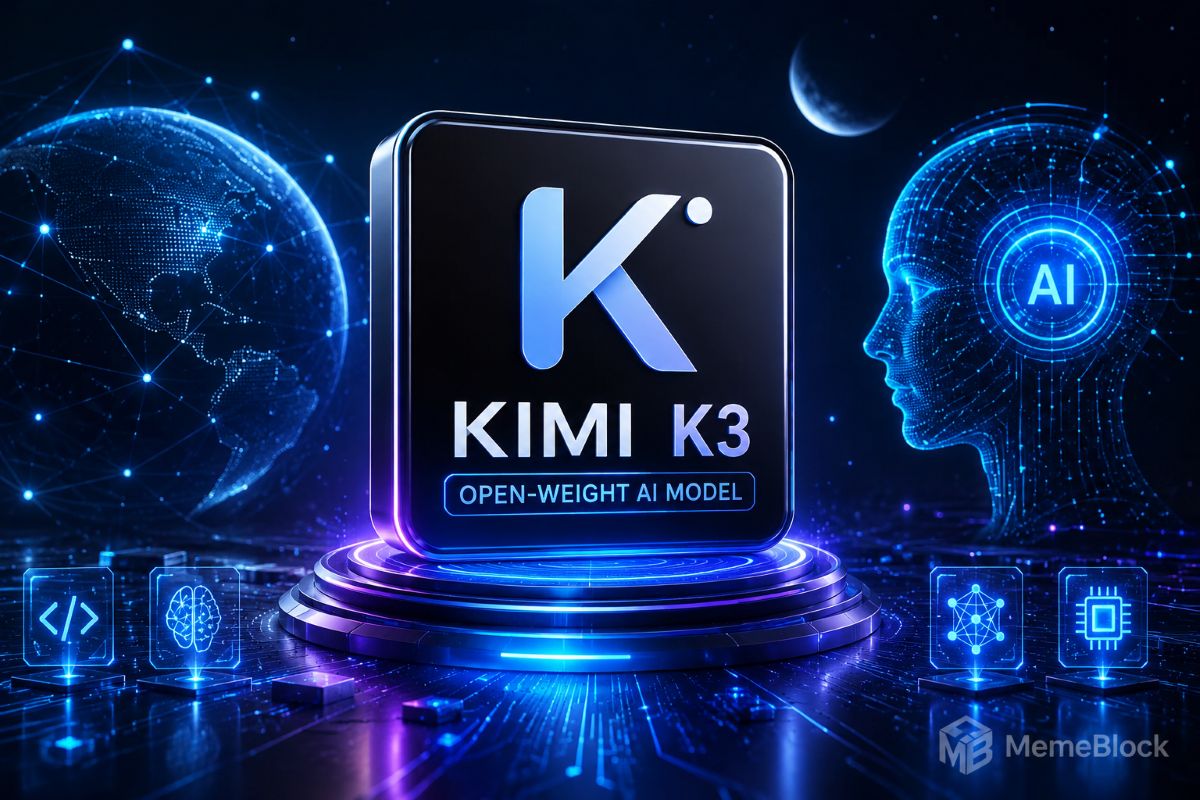
The Chinese AI developer says its new Kimi K3 model targets advanced coding, reasoning and long-context workloads. Meanwhile, it expands competition with leading U.S. AI developers.
Moonshot AI has officially unveiled Kimi K3, its newest large language model. It positions Kimi K3 as an open-weight frontier AI system designed for complex coding, reasoning, and long-context knowledge work. The company announced the release through its official Kimi platform and developer documentation. Moreover, it described K3 as the next flagship model in its Kimi family.
The release comes as Chinese AI developers continue narrowing the technological gap with major U.S. model providers. Independent reporting from Reuters, the Financial Times and Axios describes Kimi K3 as one of China’s most ambitious open-weight AI launches to date.
Kimi K3 Expands Moonshot AI’s Open-Model Strategy
According to Moonshot AI’s official documentation, Kimi K3 succeeds previous Kimi models and is now available through the company’s API platform. In addition, the developer documentation notes that earlier Kimi model series are being phased out for new users following the K3 launch.
Moonshot states that Kimi K3 is designed for:
- advanced software engineering
- long-horizon reasoning
- agent-based workflows
- large-scale document analysis
- multimodal knowledge tasks
The company also says K3 supports a context window reaching one million tokens. This allows significantly larger documents and code repositories to be processed within a single session. This specification has been widely reported by Reuters and other outlets.
Moonshot has also stated that full open weights are scheduled for public release later this month.
Company Benchmark Claims Require Continued Independent Validation
Moonshot says Kimi K3 delivers competitive performance across several reasoning, coding, and AI agent benchmarks. This is when compared with leading proprietary U.S. models.
Reuters reported that the company claims K3 outperformed several frontier systems in selected benchmark categories. In particular, GPU kernel optimization, coding, and interface development saw strong performance.
However, these benchmark comparisons primarily originate from Moonshot itself. While independent publications have reported the company’s claims, comprehensive third-party benchmarking remains limited immediately following launch.
For that reason, performance leadership should currently be regarded as Moonshot’s published claim rather than independently established industry consensus.
Why The Launch Matters For Global AI Competition
Kimi K3 arrives during an increasingly competitive period for global frontier AI development.
Chinese developers, including Moonshot AI, DeepSeek, MiniMax, and Z.ai, have accelerated releases of increasingly capable open-weight models. By contrast, U.S. firms such as OpenAI and Anthropic continue to focus primarily on proprietary commercial systems. Reuters reported that this trend has intensified competitive pressure across the sector.
Open-weight releases provide developers with greater transparency and flexibility than fully closed commercial models. This is because model parameters can eventually be downloaded, inspected, and adapted under published licensing terms.
Industry analysts cited by Axios also note that lower-cost open-weight models may increase pricing pressure across enterprise AI markets. This would happen if their real-world performance proves competitive with premium commercial offerings.
Moonshot itself is backed by major Chinese technology investors, including Alibaba and Tencent, according to Reuters and the Financial Times.
Questions Remain Despite Strong Early Reception
Although Kimi K3 has generated significant industry attention, several important questions remain unanswered.
Moonshot has not yet released a full technical report comparable to those accompanying some earlier Kimi models. Therefore, researchers are awaiting more detailed information on training methodology, evaluation procedures, and model architecture.
Independent benchmarking organizations also require additional time to validate many of the company’s reported performance results under standardized testing environments.
Another area to monitor is developer adoption. While benchmark scores often attract headlines, long-term success typically depends on ecosystem support, API reliability, licensing clarity and production performance across enterprise workloads.
What Happens Next
The next several weeks will likely determine whether Kimi K3 achieves sustained adoption beyond initial interest.
Moonshot has indicated that full open-weight availability will follow the launch, enabling researchers and developers to conduct broader independent testing.
Industry observers will also monitor:
- independent benchmark validation
- enterprise adoption
- developer ecosystem growth
- pricing competitiveness
- additional technical documentation
- responses from competing frontier AI developers
If third-party evaluations confirm Moonshot’s published benchmark claims, Kimi K3 could strengthen China’s position in the rapidly evolving global frontier AI market. At the same time, it could increase competitive pressure on proprietary AI providers.