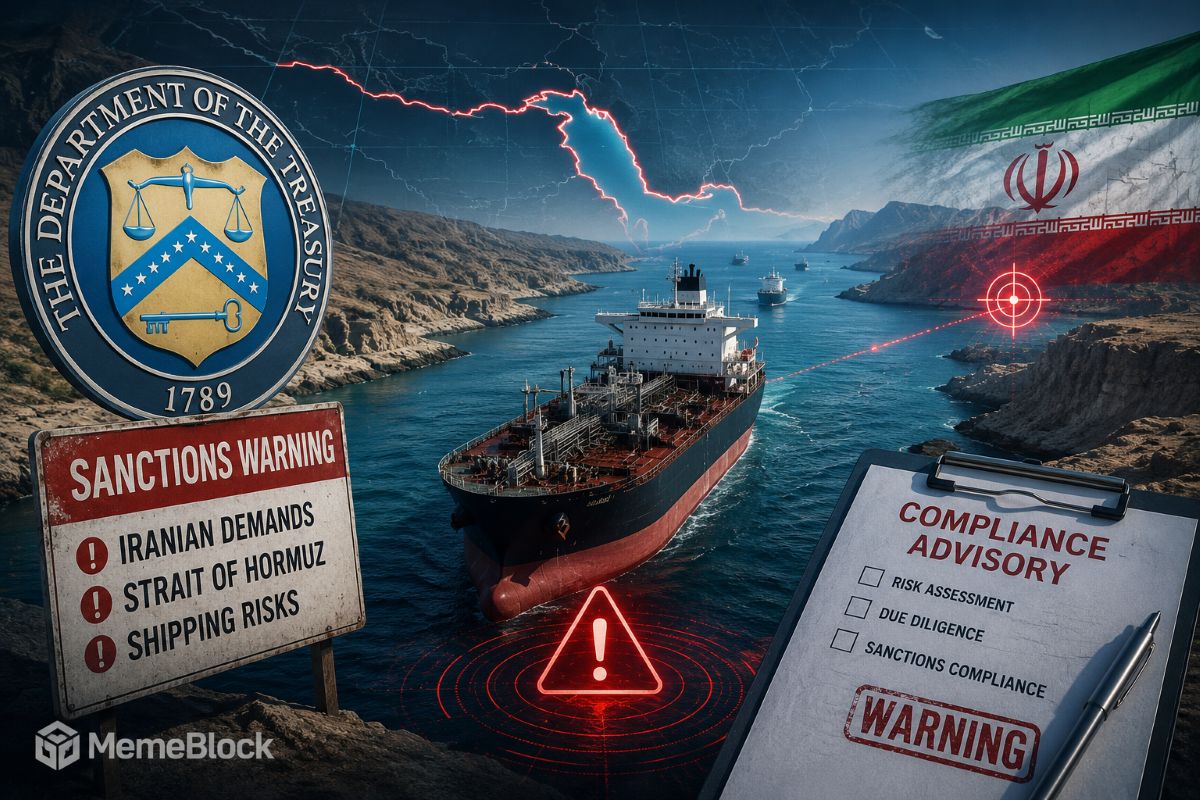
The U.S. Treasury says payments made to Iran for purported safe passage through the Strait of Hormuz, including cryptocurrency, could expose companies to U.S. sanctions.
The U.S. Department of the Treasury’s Office of Foreign Assets Control (OFAC) has issued a formal compliance alert warning that U.S. and non-U.S. persons could face sanctions exposure if they make payments to Iran in exchange for passage through the Strait of Hormuz. The guidance comes amid heightened geopolitical tensions in the Gulf and increasing concerns over maritime security.
According to the OFAC alert published on May 1, 2026, the payment method does not change the sanctions risk. Treasury officials said exposure may arise whether payment is made using fiat currency, digital assets, in-kind transfers, informal value transfers or other mechanisms.
OFAC Says The Payment Method Does Not Alter Sanctions Exposure
The Treasury’s guidance states that Iran has allegedly sought payments from commercial shipping interests in exchange for “safe passage” through the internationally recognized waterway.
According to the alert, companies that make, facilitate, or otherwise participate in such transactions could violate U.S. sanctions laws. OFAC also warned that non-U.S. businesses may face secondary sanctions if they materially support prohibited transactions involving sanctioned Iranian parties.
The advisory specifically notes that sanctions risk is not limited to conventional banking channels. Treasury said payments involving cryptocurrency, informal settlement systems, offsets or charitable structures may present similar compliance concerns if they benefit sanctioned Iranian persons or entities.
The guidance does not announce new sanctions. Instead, it explains how existing U.S. sanctions authorities could apply to these types of transactions.
Maritime Security Concerns Have Intensified
The sanctions warning arrives during a period of elevated security risks in and around the Strait of Hormuz, one of the world’s most strategically important shipping corridors.
Reuters reported on July 16 that Iranian officials described the Strait of Hormuz as a “red line” amid continuing regional hostilities, while commercial shipping companies have continued reassessing transit risks.
Independent reporting also indicates that some ship operators have declined U.S.-escorted transit arrangements because of security concerns following attacks on commercial vessels.
While these geopolitical developments provide important context, OFAC’s compliance alert itself is not contingent on any specific military event. Rather, it outlines how U.S. sanctions laws may apply if companies make payments to Iranian-linked parties.
Why The Guidance Matters For Cryptocurrency
The explicit reference to digital assets makes the advisory particularly relevant for cryptocurrency service providers, stablecoin issuers, payment processors and blockchain compliance teams.
Over the past several years, OFAC has repeatedly emphasized that sanctions obligations apply regardless of payment technology. Digital assets are treated similarly to traditional financial instruments when they facilitate transactions involving sanctioned persons.
The latest alert reinforces that principle by identifying cryptocurrency as one of several potential payment mechanisms that could expose participants to sanctions risk if used in connection with prohibited Iranian transactions.
For exchanges, custodians and compliance officers, this may require enhanced transaction monitoring, sanctions screening and customer due diligence when handling payments connected to maritime commerce in the Gulf region.
Industry Faces Legal and Operational Uncertainty
The Treasury guidance does not identify specific shipping companies or financial institutions that have violated sanctions through Strait of Hormuz payments.
Nor does it state that every vessel operating in the region faces sanctions exposure. Instead, the advisory explains that liability depends on the facts of individual transactions, including the parties involved and whether sanctioned entities receive economic benefit.
Compliance specialists note that shipping operators, insurers, banks and payment providers may need to conduct additional due diligence before facilitating transactions associated with Gulf maritime operations.
The guidance may also influence insurers, commodity traders, and logistics providers that support international energy shipments passing through the region.
What Happens Next
OFAC’s alert signals continued U.S. scrutiny of financial activity connected to Iran and the Strait of Hormuz.
Market participants will likely monitor whether Treasury follows the guidance with enforcement actions, additional sanctions designations, or updated compliance advisories.
Separately, governments and shipping companies continue to watch developments in Gulf maritime security, where geopolitical tensions remain fluid. Reuters reported this week that commercial operators are still reassessing navigation risks as military activity continues in the region.
At present, the Treasury’s position is clear: companies should not assume that alternative payment methods, including cryptocurrency, avoid U.S. sanctions exposure when transactions benefit sanctioned Iranian parties.