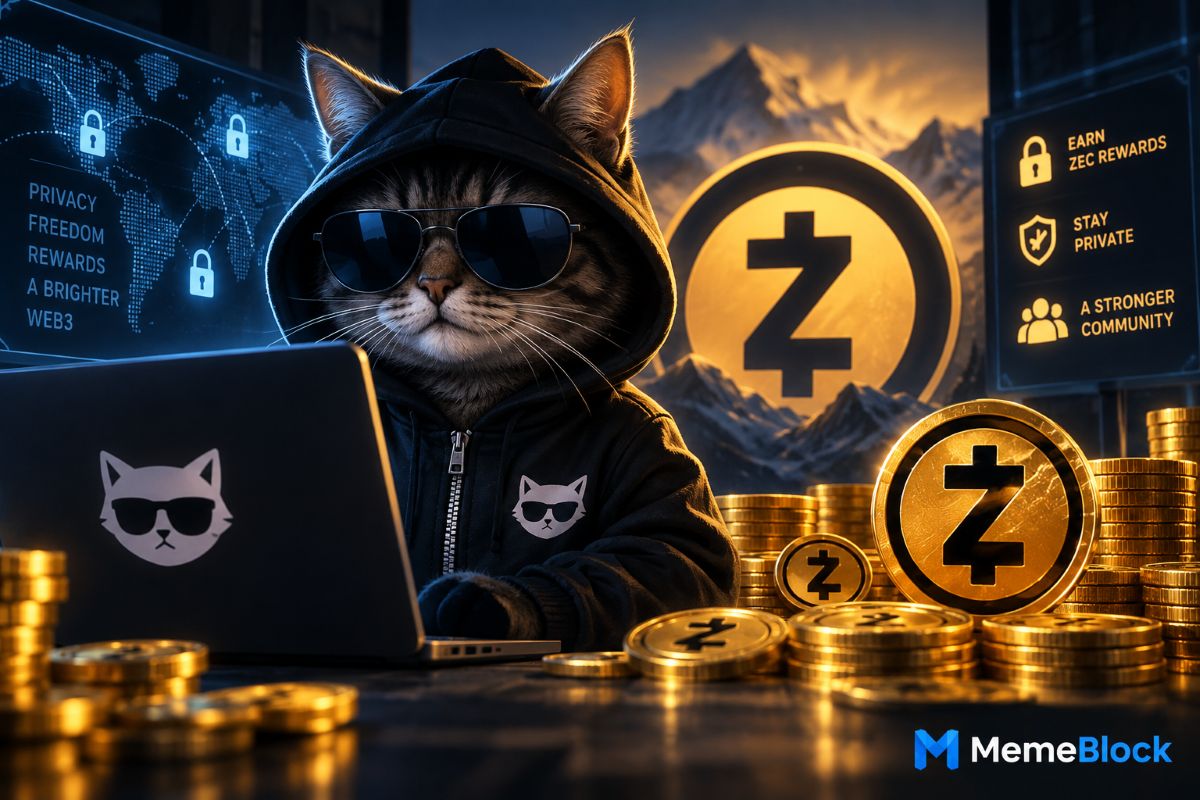
Anonymous Cat ($ZCAT) is a Solana meme token built around an unusual proposition. Holders can receive Zcash (ZEC) rewards funded by a 3% transfer fee applied to ZCAT transactions. The project identifies itself as a Token-2022 asset. It publishes no named team or social accounts. Also, it says reward amounts depend on trading activity rather than a guaranteed yield.
The token’s Solana contract is HcRLc9VDgjLeK154xDawfb1dmVJ98DoSqcwTHGqiDeJR.
The project’s official website identifies Solana as the network. It says both mint and freeze authorities have been revoked. Furthermore, it identifies StonkFun as the launch platform.
That combination gives ZCAT a structure that differs from the typical Solana meme coin. Its appeal depends not only on the token’s market value but also on whether sufficient trading activity continues. This trading activity needs to generate ZEC distributions.
How the Anonymous Cat ZCAT Reward Model Works
The central feature of the Anonymous Cat ZCAT review is its transfer-fee mechanism.
According to the project’s official website, every ZCAT move carries a permanent 3% tax. The project says those fees are routed into a reward engine that sources Zcash and distributes it to eligible holders. The amount paid is linked to transaction volume rather than a promised fixed return.
The model is important because the reward is denominated in ZEC rather than ZCAT. That separates the distribution asset from the meme token itself. Moreover, it creates a direct relationship between ZCAT activity and the Zcash market.
Independent coverage has confirmed the broad mechanics. CoinDesk reported that eligible holders were receiving ZEC from the 3% transfer tax. Also, the rewards were generated by buying, selling and transferring ZCAT rather than by an operating business producing revenue.
That distinction matters. The distributions should not be treated as business earnings or guaranteed investment income. If ZCAT trading activity falls, the fee pool available for rewards can also shrink.
ZCAT’s Launch and Exchange Expansion
Anonymous Cat was launched through StonkFun, according to the project’s own documentation and independent market coverage. The official site describes ZCAT as a Solana Token-2022 asset. It says its trading pairs include ZEC and SOL on Raydium and Meteora.
The token later expanded to centralized exchange trading. MEXC’s official listing announcement states that ZCAT was added to its Meme+ trading area on September 6, 2026, at 13:25 UTC+8. Withdrawals were scheduled to open 24 hours later. The announcement identifies the same Solana contract address.
MEXC also disclosed an important operational detail for deposits. It said the ZCAT token itself applies a 3% on-chain fee and that MEXC adds another 3% integration charge. As a result, there is an approximately 94% credited amount from a ZCAT deposit under the exchange’s stated calculation.
This creates an additional consideration for users moving ZCAT between self-custody and centralized exchange accounts. The token’s transfer economics can affect the amount ultimately received.
What the Market Data Says About ZCAT
ZCAT’s market activity has been substantial for a token launched only days before this review.
CoinGecko lists a maximum supply of 1 billion ZCAT. It reported a 24-hour trading range of $0.07866 to $0.1581 when its page was crawled. It also recorded an all-time high of $0.1755 on September 7, 2026. Because cryptocurrency prices move continuously and aggregators can update at different times, those figures should be treated as historical snapshots rather than a current quote.
AMBCrypto similarly reported a circulating supply of about 968.9 million ZCAT and a maximum supply of 1 billion. It also reported an all-time high of $0.175532 during the September 2026 launch period.
The difference between the reported market figures and the project’s reward model is worth noting. A large trading volume can increase fee generation, but it can also reflect speculative turnover. High volume alone does not establish sustainable demand for the token.
CoinDesk reported that approximately 2,320 ZEC, valued at roughly $2.8 million at the time of its September 7 report, had been distributed through more than 470,000 payouts. Those figures came from the project’s reward dashboard as reported by CoinDesk.
MemeBlock’s assessment is that the reward figure is notable but should not be interpreted as a yield generated independently of market activity. The same transaction activity that funds rewards is also part of the mechanism. This mechanism makes the token expensive to move.
Anonymous Cat ZCAT Risks and Unanswered Questions
The largest risk is the project’s anonymity.
The official website says there is no company behind ZCAT and no guaranteed reward. It also explicitly warns that taxes, reward sizes and price can change or fail. The project does not identify a named development team or publish a conventional whitepaper.
That limits the amount of information available for assessing governance, operational accountability and future development.
There is also a structural dependency on trading volume. A 3% fee can generate significant distributions when activity is high. However, the mechanism does not create an independent cash flow. CoinDesk made the same distinction in its coverage. It noted that rewards originate from ZCAT transactions rather than a business operation.
The token’s use of Token-2022 is another area that warrants ongoing monitoring. The project’s website says mint and freeze authorities have been revoked. Metaplex’s token page independently reports both authorities as disabled and identifies the asset as Anonymous Cat.
Liquidity and holder concentration should also remain on an editor’s watchlist. Metaplex reported roughly 15.59% of supply among its top 10 holders when its page was crawled. However, holder distributions can change rapidly for a newly launched token.
What Readers Should Monitor Next
For Anonymous Cat, the most useful indicators are not simply its headline price.
Readers should monitor ZCAT trading volume, liquidity, the amount of ZEC actually distributed over time, the number and eligibility of participating wallets, changes in holder concentration and the status of mint and freeze authorities.
The relationship between ZCAT activity and ZEC distributions is particularly important. If trading volume remains elevated while the reward mechanism continues operating as documented, ZCAT’s unusual tokenomics will remain relevant. If activity declines sharply, the economic value of the reward mechanism could decline with it.
For now, the evidence supports describing Anonymous Cat as a high-risk Solana meme token with a documented 3% transfer-fee mechanism and ZEC-based holder rewards. It is not a conventional yield-generating asset.
The distinction is central to evaluating the project. ZCAT’s reward system is real and observable. However, its sustainability remains dependent on continued token activity and the broader market for Zcash.