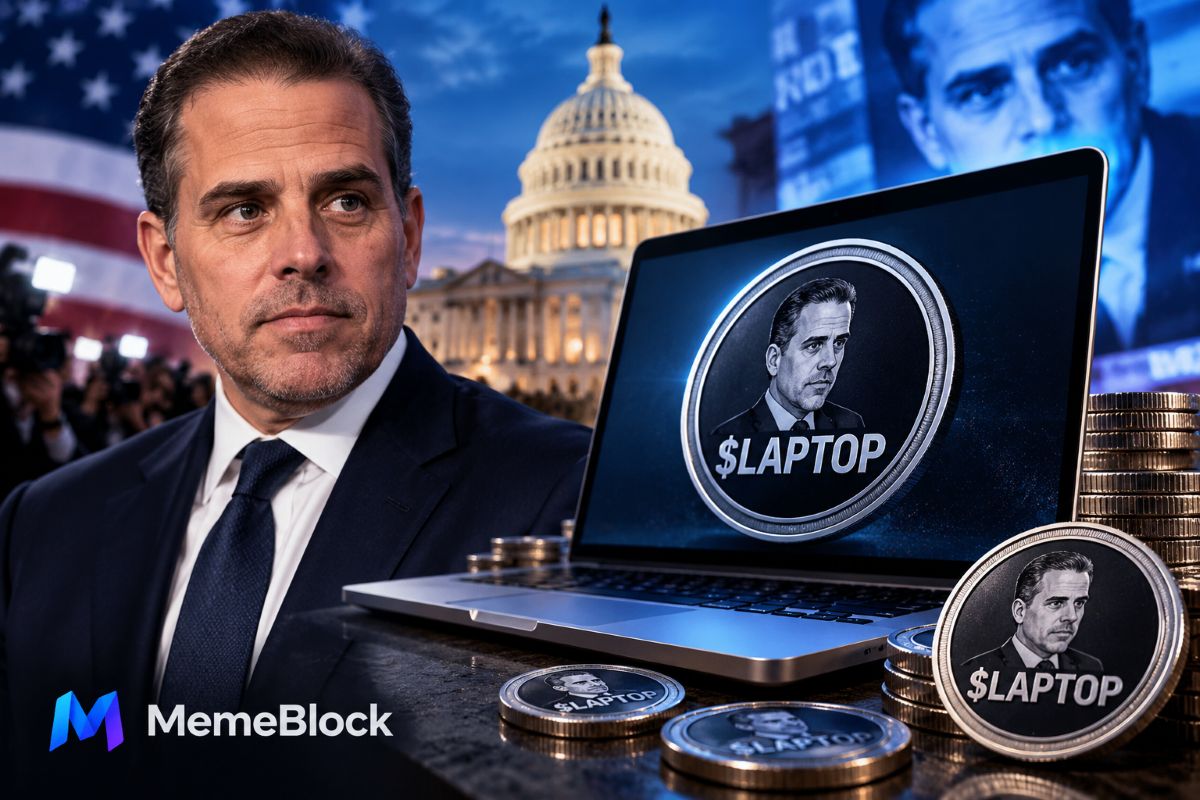
Hunter Biden confirmed the $LAPTOP ticker and Sept. 9 launch date on X. This puts the former president’s son behind a politically themed memecoin linked to his long-running laptop controversy.
Hunter Biden confirmed the launch of the $LAPTOP memecoin on Monday. He posted “$LAPTOP September 9” from his verified X account alongside a short video featuring media coverage of the laptop controversy. The Defiant reported that the post appeared at 10:55 a.m. Eastern Time on Sept. 7.
The announcement followed a Wall Street Journal report that Hunter Biden is part of the founding team behind the token. The token is planned for launch on Base, the Ethereum layer-2 network associated with Coinbase.
The project is expected to launch on Sept. 9, 2026, meaning there is not yet a reliable established market price for the official token as of Sept. 8. Multiple unrelated tokens already use the LAPTOP ticker, creating a material identification risk for traders and readers.
Hunter Biden’s LAPTOP Confirmation Came After WSJ Report
The sequence of events is unusually clear.
The Wall Street Journal first reported on Sept. 7 that Hunter Biden was preparing a meme cryptocurrency named LAPTOP. Four minutes later, according to The Defiant, Biden posted the ticker and launch date on his verified X account.
Forbes separately reported that the planned token would launch Sept. 9 and that one billion tokens were expected to be issued.
The announcement ties the token directly to the laptop that became a major political controversy during the 2020 U.S. presidential election. Meanwhile, the project’s own website frames the token as an effort to “reclaim the narrative” surrounding the episode.
The official project site currently identifies a Base contract as 0xB095274743941e953c746F9C228DA9c18Bb6ec29. However, its trading and airdrop interfaces still display “Coming soon.”
$LAPTOP Tokenomics Differ Across Disclosures
The planned supply is 1 billion LAPTOP tokens, but the allocation picture requires qualification.
The Wall Street Journal reported that founders, including Biden, would control 30% of the supply, subject to a six-month lockup and two-year vesting period. It also reported that 20% would be distributed through airdrops involving people who lost money on Donald Trump’s $TRUMP memecoin, Biden’s Substack subscribers and a mailing list associated with video journalist Andrew Callaghan.
The project’s current website presents a more detailed structure. It lists 30% for founders, 30% for prediction-linked allocations, 10% for a day-one airdrop, 10% for a future airdrop, 10% for liquidity, 5% for the foundation treasury and 5% for charity. In addition, it says 35% of supply is unlocked at token generation and that the full supply unlocks over 36 months.
That represents a material difference from the earlier media description.
MemeBlock therefore treats the project’s current website as the latest disclosed allocation framework. At the same time, it retains the Wall Street Journal’s earlier figures as a separate report. The two should not be combined into one tokenomics table without further confirmation from the issuer.
The project also assigns 30% of supply to 30 real-world prediction outcomes. According to the website, tokens associated with events that resolve in the project’s favor are burned. In contrast, tokens associated with unsuccessful outcomes are directed to charity.
Copycat LAPTOP Tokens Create an Identification Problem
The launch is already generating a separate market problem: the LAPTOP ticker is not unique.
The Defiant reported that at least 14 copycat LAPTOP tokens appeared across four other networks within an hour of the initial reports. Together, these had a combined trading volume of about $6.9 million.
That activity does not establish demand for Hunter Biden’s official token.
It also means that a token displaying the LAPTOP ticker, a Hunter Biden image or a purported contract address should not automatically be treated as the official asset. The project’s website identifies the Base contract. Meanwhile, the project’s X account identifies itself as the LAPTOP account and lists the same Base contract.
The distinction is particularly important because unrelated LAPTOP tokens have previously traded on Solana and other networks. In fact, search results also show multiple current trading pairs using the ticker, reinforcing the need for contract-level verification rather than ticker-level identification.
As of this report, MemeBlock is not assigning a market price to the official $LAPTOP token because the project’s scheduled launch has not yet occurred. Third-party market pages can refer to different assets.
The Token Enters A Changing Regulatory Environment
The launch also arrives against a more developed U.S. regulatory discussion around meme coins.
In February 2025, the SEC’s Division of Corporation Finance said typical meme coins are generally purchased for entertainment, social and cultural purposes. Their value is primarily driven by market demand and speculation. The staff characterized such meme coins as similar to collectibles and noted their limited or nonexistent functionality.
That statement does not provide blanket protection for every crypto transaction or token structure. Meanwhile, SEC Commissioner Caroline Crenshaw separately criticized the staff’s approach and argued that the analysis of crypto assets can depend on the economic realities of the transaction.
For $LAPTOP, the project’s own disclosures describe the asset as a memecoin for entertainment and community participation. They also state that it does not represent equity, ownership or other economic interest in a company or asset.
The distinction between the project’s characterization and the legal treatment of particular transactions remains important.
What Readers Should Monitor Before the Launch
The first verification point is the Base contract. Readers should compare any token they encounter with the contract published through the project’s official channels rather than relying on the ticker.
The second is the final token distribution. The difference between the Wall Street Journal’s initial description and the project’s current website should be resolved through an authoritative issuer disclosure.
The third is actual liquidity and trading activity after launch. No meaningful conclusion about market capitalization, price performance or investor demand should be drawn from copycat tokens trading before the official launch.
Finally, the project’s prediction-linked supply mechanism warrants monitoring because up to 30% of the stated supply is connected to future event outcomes. The website says successful outcomes result in burns and unsuccessful outcomes result in charitable distributions. However, those future actions should be verified on-chain when they occur rather than treated as completed token burns today.
For now, the confirmed news is narrower: Hunter Biden has publicly endorsed the $LAPTOP ticker and Sept. 9 launch date. Project materials identify Base as the intended network. The remaining questions concern final distribution mechanics, launch liquidity, exchange access and how the project distinguishes its official token from the growing number of copycats.